Hyperbolic Functions Engine
Evaluates all 6 hyperbolic functions via Euler exponential definitions.
Benchmarks:
Institutional Mathematics ReferenceApplied Analysis & Physics Foundations
The Comprehensive Handbook of Inverse Trigonometric and Hyperbolic Functions
Inverse trigonometric functions allow mathematicians to recover angular values from numerical ratios, while hyperbolic functions formulate the geometry of the unit hyperbola (x² - y² = 1), governing suspension cables, relativistic spacetime rapidity, and complex integration.
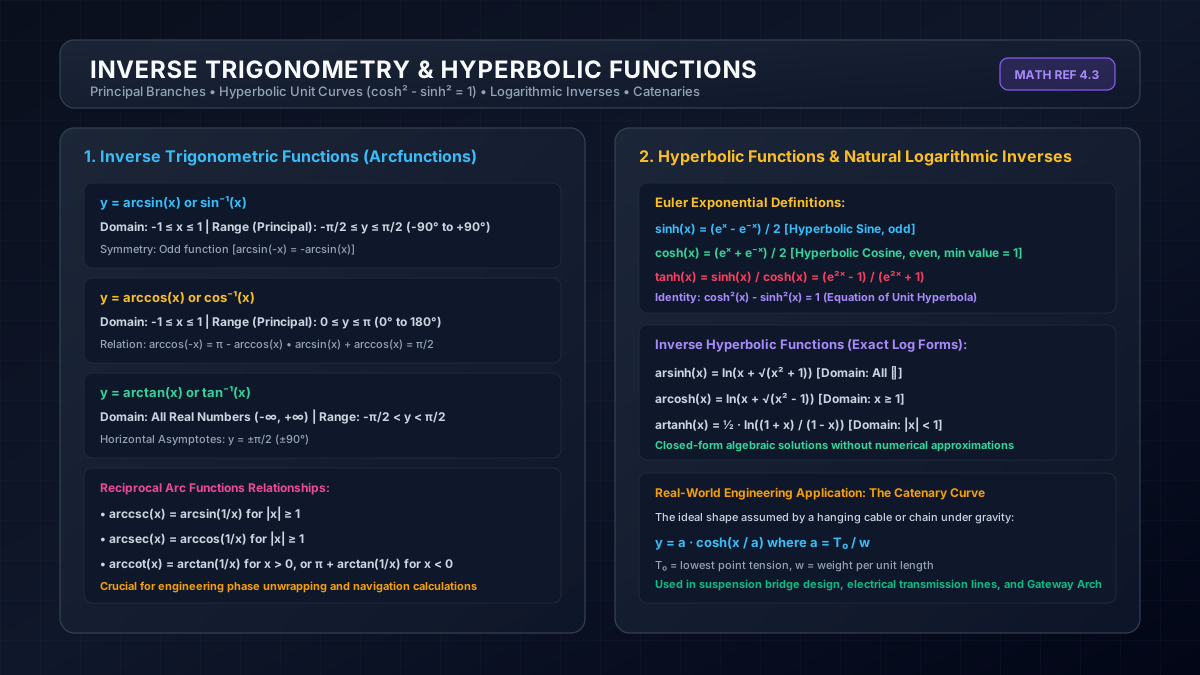
Figure 1: Inverse Principal Branches, Hyperbolic Exponential Definitions, and the Catenary Wire Curve.
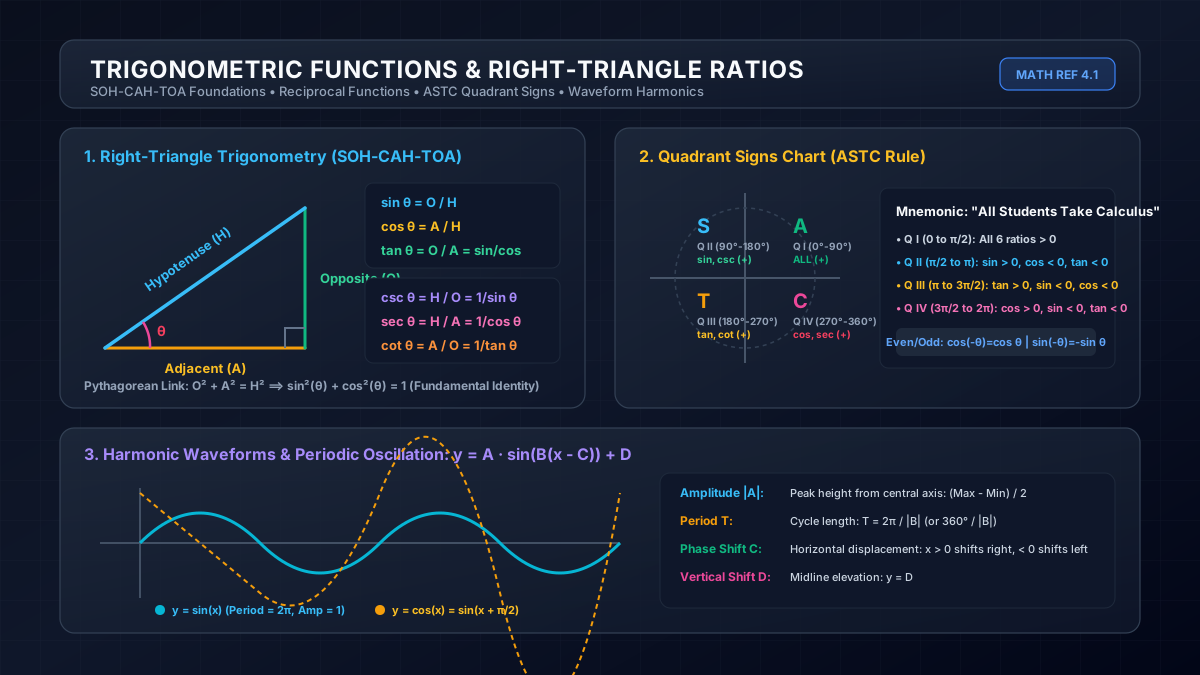
Figure 2: Geometric Right-Triangle Foundations and Reciprocal Ratio Relationships.
1. Why Are Principal Branches Strictly Required for Inverse Trig?
Because trigonometric functions like y = sin(x) are periodic (repeating indefinitely every 2π radians), they fail the horizontal line test. An infinite number of distinct angles share the exact same sine value (e.g., sin(30°) = sin(150°) = sin(390°) = 0.5). To construct a well-defined mathematical function with a single unique output, mathematicians restrict the domain of the original function to a principal branch:
- y = arcsin(x): Restricted to -π/2 ≤ y ≤ π/2 (-90° to +90°). Domain: -1 ≤ x ≤ 1.
- y = arccos(x): Restricted to 0 ≤ y ≤ π (0° to 180°). Domain: -1 ≤ x ≤ 1.
- y = arctan(x): Restricted to -π/2 < y < π/2 (-90° to +90°). Domain: (-∞, +∞).
2. The Geometry of the Unit Hyperbola & Euler Exponentials
Just as circular trigonometric functions parameterize the unit circle x² + y² = 1 via (cos t, sin t), hyperbolic functions parameterize the right branch of the unit hyperbola x² - y² = 1 via (cosh t, sinh t):
Hyperbolic Sine:sinh(x) = (eˣ - e⁻ˣ) / 2
Hyperbolic Cosine:cosh(x) = (eˣ + e⁻ˣ) / 2
Squaring both terms immediately yields the fundamental hyperbolic identity:
cosh²(x) - sinh²(x) = 1
3. Engineering Applications: The Hanging Catenary Cable
A flexible chain or transmission cable suspended between two equal-height towers does not form a parabola, as Galileo initially conjectured, but rather a catenary (from Latin catena, chain), derived mathematically by Huygens, Leibniz, and Johann Bernoulli in 1691.
y(x) = a · cosh(x / a) - a, where a = T₀ / w
Here, T₀ represents the minimum horizontal tension at the midpoint and w is the weight per unit length. The total sag at the center for span L is:
Sag = a · [cosh(L / 2a) - 1]