Math Calculator
Trigonometry
Dual Angles for Product & Sum Conversions
Transforms multiplication of waves into sum of harmonics, and vice-versa.
Institutional Mathematics ReferenceAlgebraic Harmonics & Wave Mechanics
The Comprehensive Handbook of Trigonometric Identities, Double Angles, and Sum-Product Transforms
Trigonometric identities form the algebraic backbone of calculus integration, Fourier analysis, digital signal processing (DSP), quantum mechanics, and telecommunications modulation.
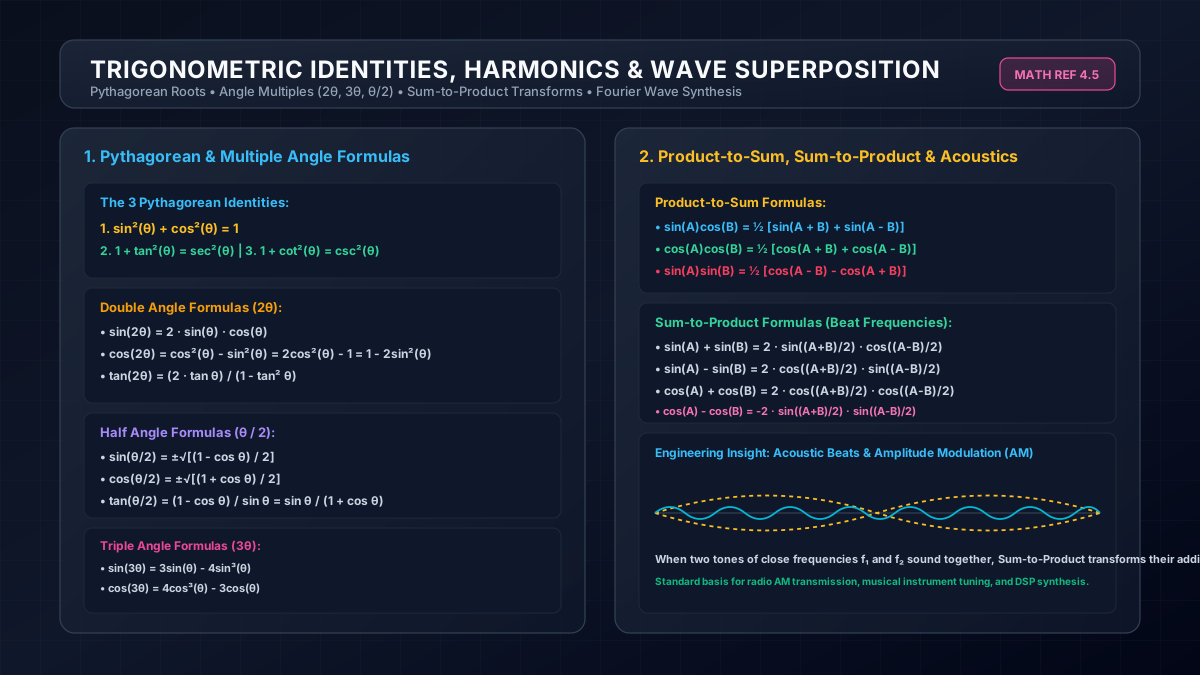
Figure 1: Fundamental Pythagorean Identities, Angle Multiples, and DSP Waveform Superposition.
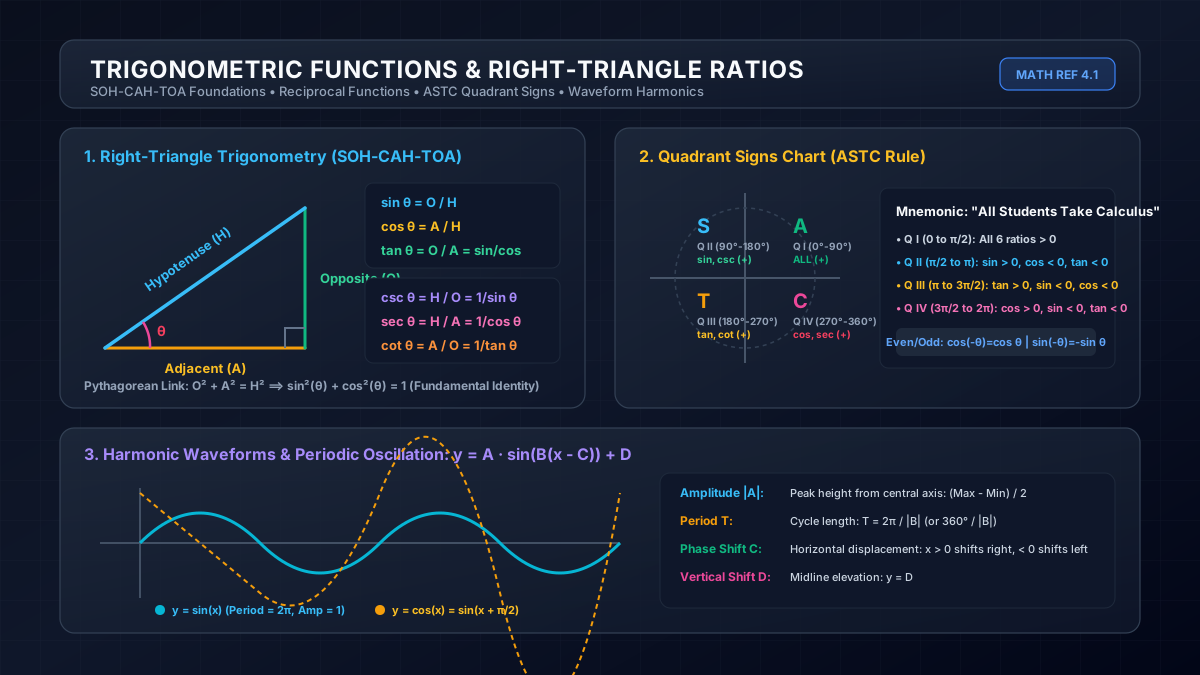
Figure 2: Right-Triangle SOH CAH TOA Foundations and Periodic Sinusoids.
1. The Three Pythagorean Identities and Algebraic Derivations
The most famous identity in all of trigonometry arises directly from applying Pythagoras' theorem to the unit circle:
sin²(θ) + cos²(θ) = 1
Dividing this master equation by cos²(θ) yields the tangent-secant identity:
[sin²(θ) / cos²(θ)] + [cos²(θ) / cos²(θ)] = 1 / cos²(θ) ⟹ 1 + tan²(θ) = sec²(θ)
Similarly, dividing by sin²(θ) produces the cotangent-cosecant identity:
1 + cot²(θ) = csc²(θ)
2. Double Angle & Power-Reduction Formulas
Double angle formulas permit reducing higher frequencies to baseline angular terms:
- Sine Double Angle: sin(2θ) = 2 · sin(θ) · cos(θ)
- Cosine Double Angle: cos(2θ) = cos²(θ) - sin²(θ) = 2cos²(θ) - 1 = 1 - 2sin²(θ)
- Tangent Double Angle: tan(2θ) = (2 · tan θ) / (1 - tan² θ)
Rearranging cos(2θ) produces the power-reduction identities, which are essential for evaluating integral calculus terms like ∫ sin²(x) dx:
sin²(θ) = [1 - cos(2θ)] / 2
cos²(θ) = [1 + cos(2θ)] / 2
3. Acoustic Beat Frequencies and Amplitude Modulation (AM)
When two sound waves with slightly differing frequencies f₁ and f₂ arrive at the human ear simultaneously, the Sum-to-Product identity models their auditory superposition:
sin(2πf₁t) + sin(2πf₂t) = 2 · cos[2π · ((f₁ - f₂) / 2) · t] · sin[2π · ((f₁ + f₂) / 2) · t]
The human ear perceives this as a single tone vibrating at average frequency (f₁ + f₂)/2 whose volume pulses rhythmically at the beat frequency f_beat = |f₁ - f₂|. Musicians use this phenomenon to tune guitars and pianos.
Frequently Asked Questions (FAQ)
About Sum to Product Calculator
Comprehensive trigonometric identities and transformations suite. Solve double-angle, triple-angle, half-angle formulas, product-to-sum conversions, and verify Pythagorean identities with step-by-step arithmetic.
Why this page helps
- Essential tool for calculus trigonometric substitution and integration
- Analyzes acoustic wave interference and audio synthesizer harmonics
- Instant symbolic proof verification for college and high-school mathematics
How to use it well
- Select your expansion mode: Multiple & Half Angles (2θ, 3θ, θ/2), Sum-to-Product / Product-to-Sum, or Pythagorean Identity Verifier.
- Input your base angle(s) in degrees or radians.
- Review evaluated expansion values, symbolic algebraic expressions, and numerical parity checks.
- Download calculation reports or copy formulas for coursework or engineering tasks.