Law of Cosines Parameters
c² = a² + b² - 2ab·cos(C)
Institutional Mathematics ReferenceOblique Trigonometry & Geodesy Principles
The Definitive Guide to the Law of Sines, Law of Cosines, and Oblique Triangle Geometry
When triangles lack a convenient 90-degree right angle, classical SOH CAH TOA cannot be applied directly. The Law of Sines and Law of Cosines generalize trigonometry to all arbitrary planar triangles, providing exact algorithms for civil surveying, navigation geodesy, and structural engineering.
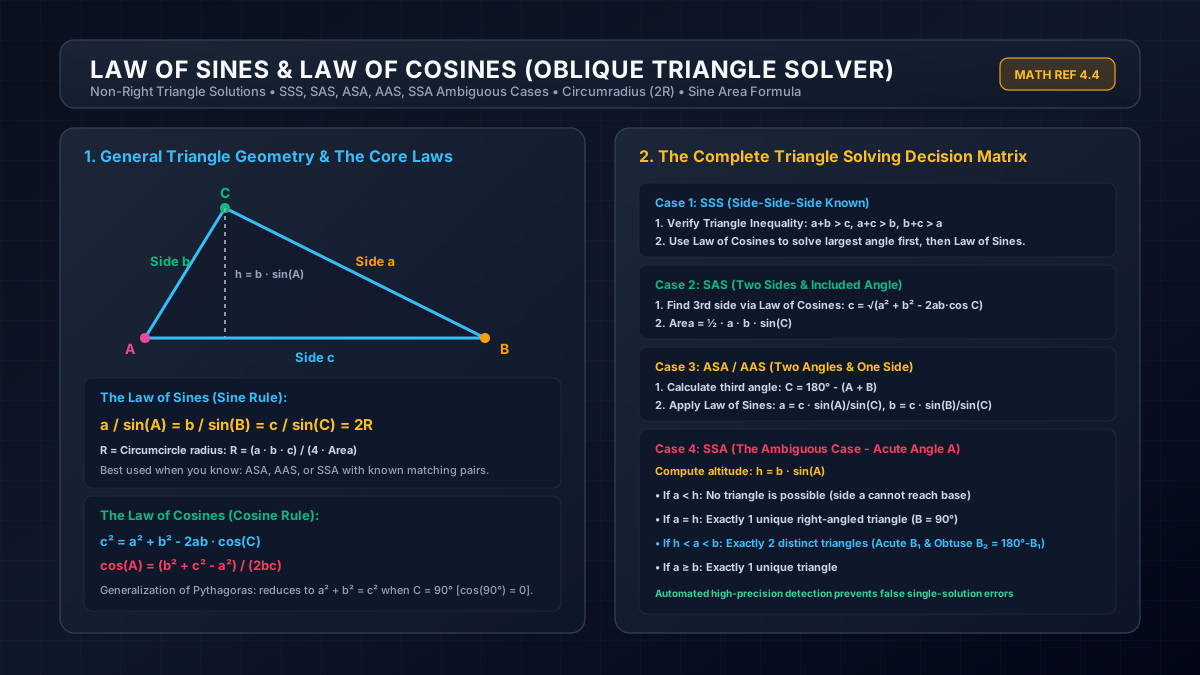
Figure 1: Oblique Triangle Anatomy, SSS/SAS/SSA Decision Trees, and the Ambiguous Case.
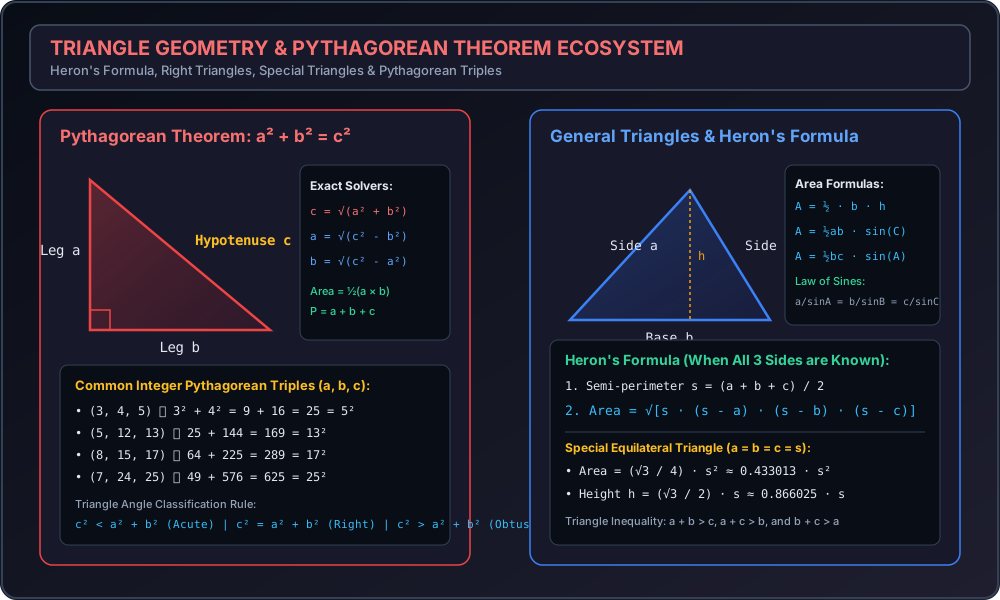
Figure 2: Triangle Altitude, Heron’s Formula, Incircle, and Circumcircle Geometry.
1. The Law of Sines and the Circumscribed Circle (2R)
In any arbitrary planar triangle with side lengths a, b, c and respective opposite angles A, B, C, the ratio of each side to the sine of its opposite angle is constant and equal to the diameter (2R) of the triangle's circumscribed circle (circumcircle):
a / sin(A) = b / sin(B) = c / sin(C) = 2R
The Law of Sines is optimal when you are given:
- AAS (Angle-Angle-Side): Two angles and a non-included side. Third angle is found via C = 180° - (A+B).
- ASA (Angle-Side-Angle): Two angles and their included side.
- SSA (Side-Side-Angle): Known as the Ambiguous Case, which may yield 0, 1, or 2 distinct triangles.
2. Mastering the SSA Ambiguous Case (0, 1, or 2 Triangles)
When given two sides and an angle not between them (SSA, with acute angle A and known sides a and b), the unknown side must span the altitude h = b · sin(A):
Case 1: a < hNo triangle exists. The opposite side a is too short to reach the baseline.
Case 2: a = hExactly one right triangle exists with ∠B = 90°.
Case 3: h < a < bExactly two triangles exist! One where ∠B is acute (B₁ = arcsin(sin B)) and one where ∠B is obtuse (B₂ = 180° - B₁).
Case 4: a ≥ bExactly one unique triangle exists because the second swing would produce an angle > 180°.
3. The Law of Cosines: The Generalized Pythagorean Theorem
When three sides (SSS) or two sides and an included angle (SAS) are known, the Law of Sines cannot be initialized because no matching side-angle pair exists. The Law of Cosines bridges this gap:
c² = a² + b² - 2ab · cos(C)
Notice that when C = 90°, cos(90°) = 0, reducing the equation precisely to the classical Pythagorean theorem: c² = a² + b². To solve for an angle from three known sides:
cos(A) = (b² + c² - a²) / (2bc)