Reference & Coterminal Solver
Calculates the acute reference angle θᵣ and multi-revolution coterminal positive/negative angles.
Institutional Mathematics ReferenceStandards from NIST & International Bureau of Weights
The Comprehensive Handbook of the Unit Circle, Angular Units, and Polar Geometry
A comprehensive guide to understanding angular positions, radian mechanics, exact algebraic radical coordinates, reference angle transformations, and polar-to-Cartesian vector mappings in applied STEM fields.
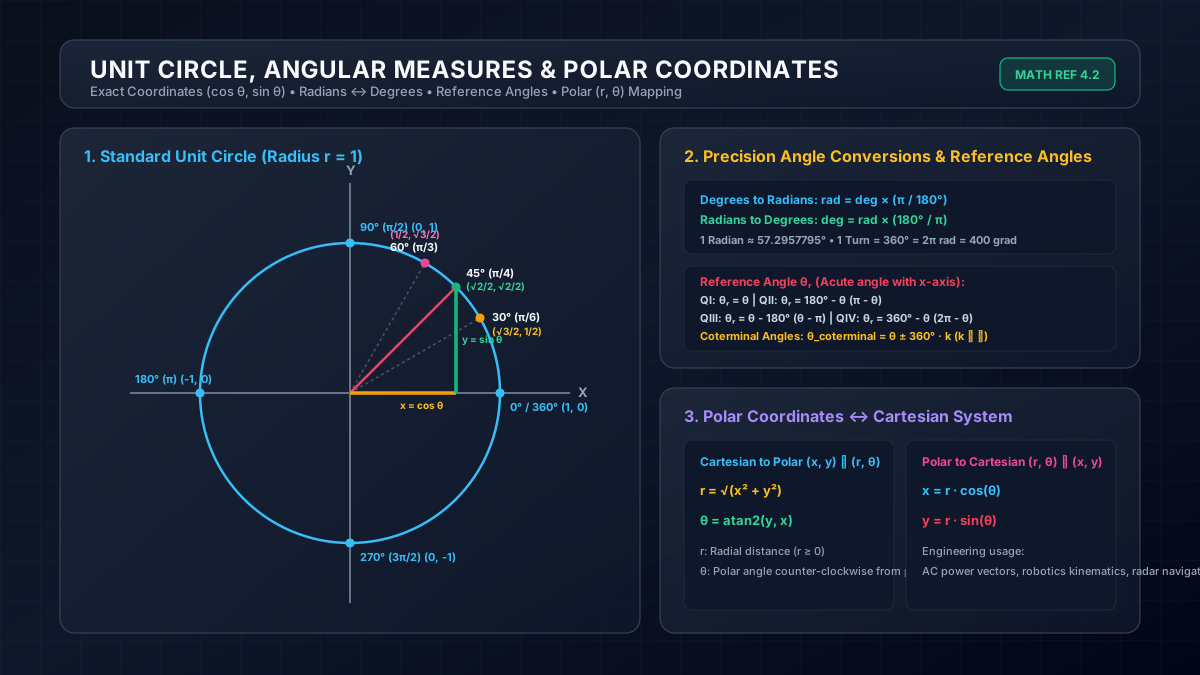
Figure 1: Standard Unit Circle (r=1) Coordinates, Reference Angle Rules, and Polar Conversions.
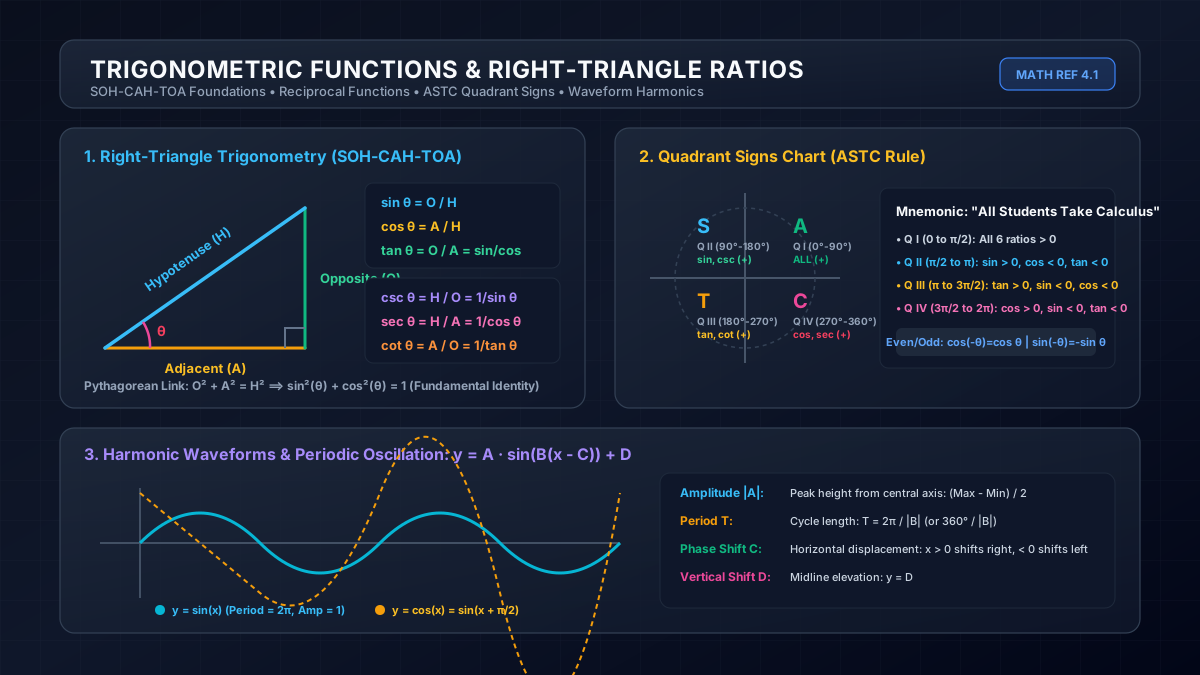
Figure 2: Right-Triangle SOH CAH TOA Definitions and Harmonic Waveform Properties.
1. Why the Unit Circle is the Central Rosetta Stone of Trigonometry
The unit circle is defined algebraically in the Cartesian coordinate plane by:
x² + y² = 1
When any radial segment of length r = 1 is drawn from origin (0, 0) at angle θ relative to the positive x-axis, its endpoint coordinates are identically (x, y) = (cos θ, sin θ). This elegant correspondence unifies geometry and algebra:
- Horizontal projection x: Directly measures cos(θ).
- Vertical projection y: Directly measures sin(θ).
- Pythagorean Theorem: x² + y² = (cos θ)² + (sin θ)² = 1.
2. The Algebraic Logic of Reference Angles (θᵣ)
A reference angle θᵣ is the smallest positive acute angle (0° ≤ θᵣ ≤ 90°) formed between the terminal side of the angle and the horizontal x-axis. Because circles are symmetric across both axes, the trigonometric ratios for any angle θ are numerically identical to those of θᵣ, differing only in sign:
Quadrant I (0° - 90°):θᵣ = θ
Quadrant II (90° - 180°):θᵣ = 180° - θ [or π - θ]
Quadrant III (180° - 270°):θᵣ = θ - 180° [or θ - π]
Quadrant IV (270° - 360°):θᵣ = 360° - θ [or 2π - θ]
3. Polar Coordinates in Aviation, Radar, and Robotics
While rectangular Cartesian coordinates (x, y) represent positions via grid street blocks, polar coordinates (r, θ)represent points via line-of-sight distance r and directional azimuth angle θ.
Radar sweeps, LiDAR scanner sensors in autonomous vehicles, and sonar ping navigation naturally gather data in polar form. The transformation between both systems is:
Polar to Cartesian:x = r · cos(θ)
y = r · sin(θ)
y = r · sin(θ)
Cartesian to Polar:r = √(x² + y²)
θ = atan2(y, x)
θ = atan2(y, x)