Evaluate Angle Ratios
Input an angle to evaluate sin, cos, tan, cot, sec, csc, reference angle, and quadrant classification.
Standard Benchmarks:
Institutional Mathematics ReferenceUpdated for Academic & Engineering Year 2026
The Comprehensive Handbook of Trigonometric Functions, Ratios, and Wave Mechanics
From the geometric foundations of right triangles and circular projections to modern telecommunications, Fourier series, and quantum mechanics, trigonometry provides the mathematical vocabulary to quantify periodic cycles, rotational kinematics, and angular spatial structures.
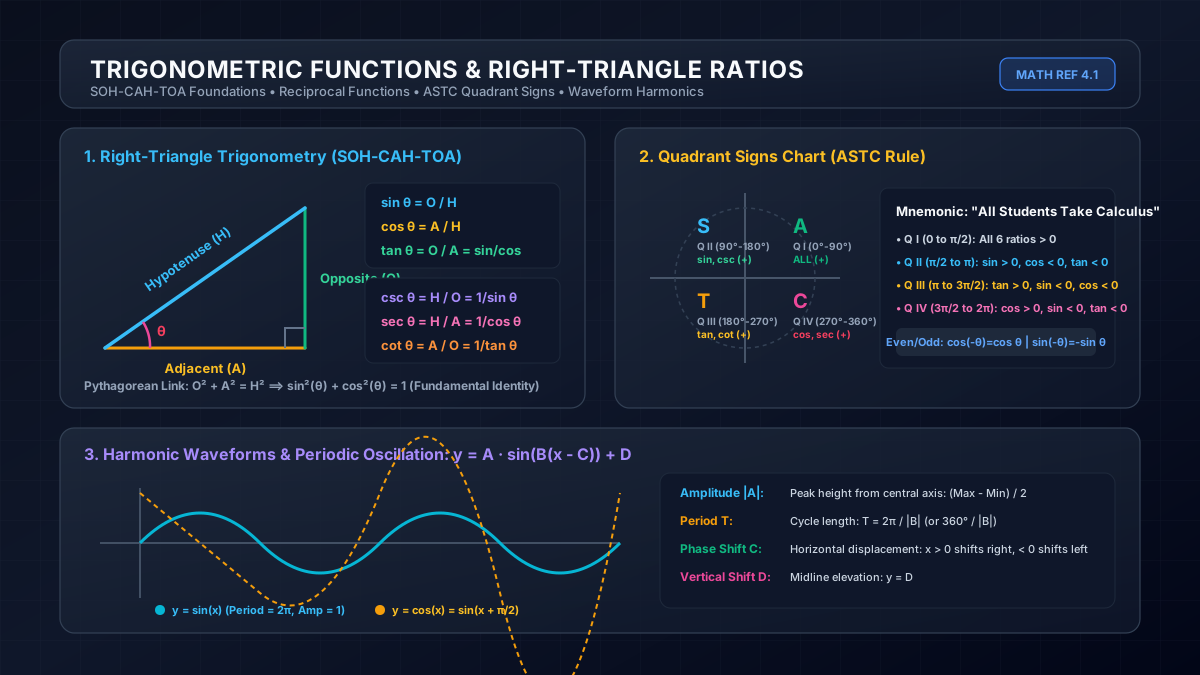
Figure 1: SOH CAH TOA Right-Triangle Geometry, Reciprocal Functions, and Quadrant Sign Rules.
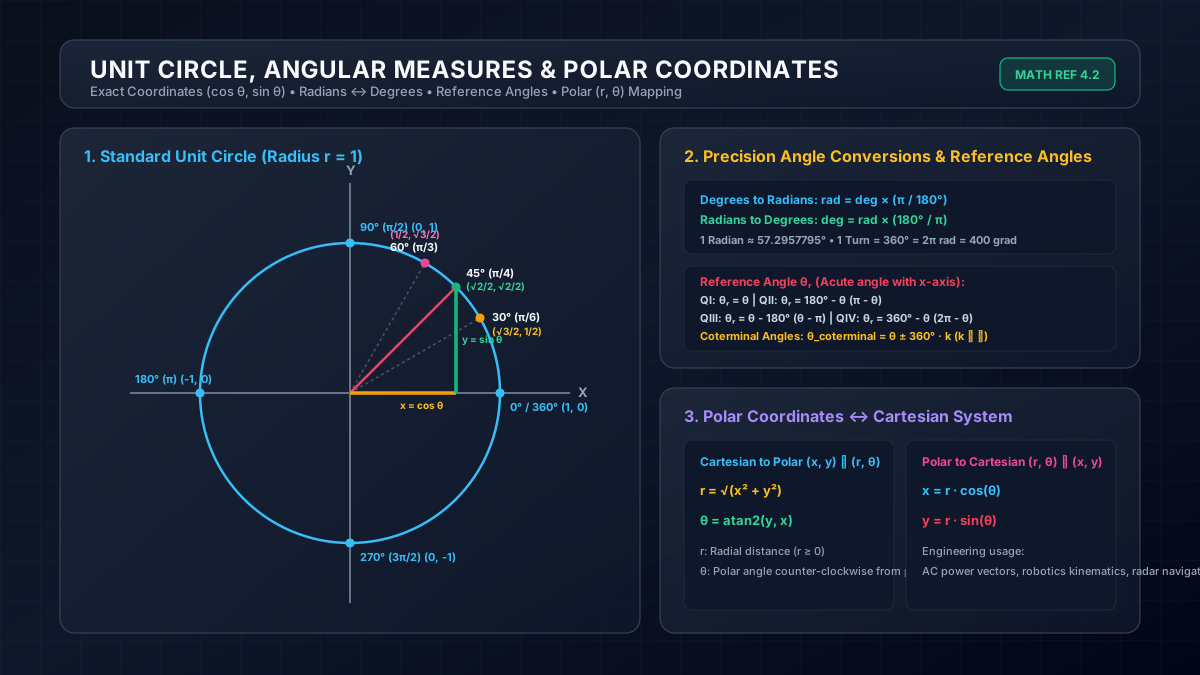
Figure 2: Unit Circle Angular Coordinates (cos θ, sin θ), Radian-Degree Conversions, and Polar Vectors.
1. Right-Triangle Trigonometry & SOH CAH TOA
Trigonometry traces its etymology to the ancient Greek words trigōnon (triangle) and metron (measure). In an Euclidean right-angled triangle containing one 90° angle and two acute angles whose sum equals 90°, the ratio between any pair of sides depends solely on the measure of either acute angle. Let θ denote one of these acute angles:
Sine Ratio (SOH)sin(θ) = Opposite / Hypotenuse
Cosine Ratio (CAH)cos(θ) = Adjacent / Hypotenuse
Tangent Ratio (TOA)tan(θ) = Opposite / Adjacent
The reciprocal functions naturally follow by inverting each fundamental ratio:
- Cosecant: csc(θ) = 1 / sin(θ) = Hypotenuse / Opposite
- Secant: sec(θ) = 1 / cos(θ) = Hypotenuse / Adjacent
- Cotangent: cot(θ) = 1 / tan(θ) = Adjacent / Opposite
2. The Unit Circle, Angular Radians, and Extended Real Domains
While right triangles restrict angle θ strictly between 0° and 90° (0 < θ < π/2), the Unit Circle— a circle of radius r = 1 centered at Cartesian origin (0, 0) with equation x² + y² = 1 — extends trigonometric functions across all real numbers (-∞, +∞).
For any real angle θ measured counter-clockwise from the positive horizontal x-axis, the ray intersects the circle at exactly point (x, y) = (cos θ, sin θ). Consequently, the tangent represents the slope of the radial line: tan(θ) = y / x = sin(θ) / cos(θ).
The ASTC Quadrant Rule ("All Students Take Calculus"):
Quadrant I (0° to 90°): Both x > 0 and y > 0. All 6 trigonometric ratios are strictly positive (+).
Quadrant II (90° to 180°): x < 0 and y > 0. Only Sine and Cosecant are positive (+). Cosine, Tangent, Secant, and Cotangent are negative (-).
Quadrant III (180° to 270°): Both x < 0 and y < 0. Tangent and Cotangent are positive (+). Sine and Cosine are negative (-).
Quadrant IV (270° to 360°): x > 0 and y < 0. Only Cosine and Secant are positive (+). Sine and Tangent are negative (-).
3. Master Benchmark Table of Exact Algebraic Surds
In higher mathematics, calculus, and physics, working with algebraic radical expressions (surds) rather than rounded decimals prevents compounding numerical errors during integration or matrix inversion.
| Degrees | Radians | sin(θ) | cos(θ) | tan(θ) | sec(θ) |
|---|---|---|---|---|---|
| 0° | 0 | 0 | 1 | 0 | 1 |
| 30° | π / 6 | 1 / 2 | √3 / 2 | √3 / 3 | 2√3 / 3 |
| 45° | π / 4 | √2 / 2 | √2 / 2 | 1 | √2 |
| 60° | π / 3 | √3 / 2 | 1 / 2 | √3 | 2 |
| 90° | π / 2 | 1 | 0 | Undefined | Undefined |
4. Periodic Harmonic Oscillations in Engineering
Any sinusoidal continuous wave can be fully characterized by four independent algebraic parameters in the general expression:
y(t) = A · sin(ωt - φ) + y₀ = A · sin(2πf · t - φ) + y₀
Where:
- Amplitude |A|: The peak deviation of the function from its central equilibrium line. In acoustic audio, amplitude dictates volume (decibels); in AC electricity, it defines peak voltage.
- Angular Frequency ω = 2π / T: Dictates the repetition speed per unit time in radians per second.
- Period T = 2π / |B|: The temporal or spatial duration required to complete one full 360° oscillation cycle.
- Phase Shift φ / B: The horizontal offset along the time axis, critical in alternating current (power factor = cos φ) and wireless antenna arrays.