Left Null Space
Solutions to y^T A = 0 / Null(A^T)
Transformation Matrix A (Columns = Vectors v₁, v₂, v₃)
Subspace Solution
Exact BasisLeft Null Space / Cokernel (Null(A^T))
Nullity = 1
Rank (2) + Nullity (1) = 3 (Total Columns)
Solutions to y^T A = 0. By Strang's Theorem, LeftNull(A) is the orthogonal complement of Col(A) in ℝ³.
Academic Reference & Subspace Geometry
Vector Subspaces, Orthogonal Projections & Gram-Schmidt Orthonormalization
Gilbert Strang's 4 fundamental subspaces, orthogonal decomposition theorems, Gram-Schmidt algorithms, and least-squares plane projections.
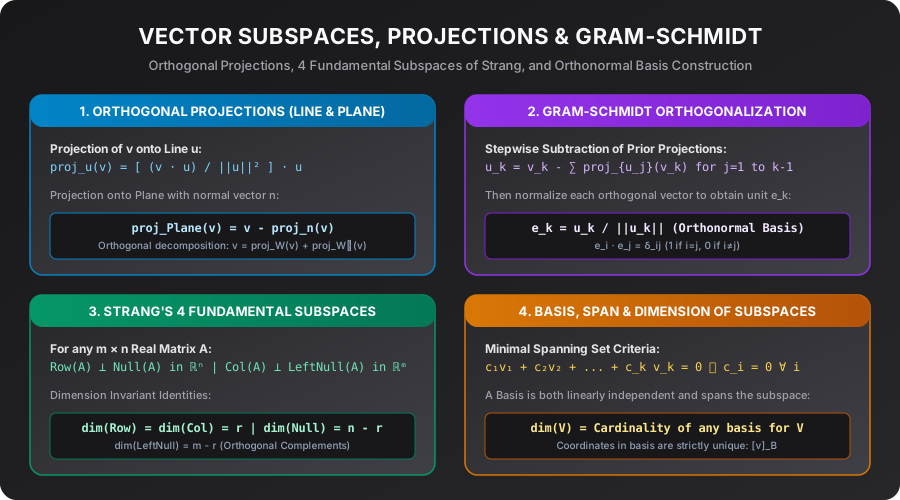
1. Orthogonal Projections onto Lines and Hyperplanes
The orthogonal projection of a vector v onto a 1-dimensional subspace spanned by a non-zero vector u is defined by minimizing the Euclidean distance ||v - cu|| over all real scalars c. Setting the derivative of the squared error to zero yields:
proj_u(v) = [ (v · u) / ||u||² ] · u
When projecting onto an arbitrary flat plane passing through the origin with normal vector n = ⟨A, B, C⟩, any vector v decomposes uniquely into a component parallel to the normal and a component parallel to the plane:
proj_Plane(v) = v - proj_n(v) = v - [ (v · n) / ||n||² ] · n
2. The Gram-Schmidt Orthonormalization Algorithm
Given a set of linearly independent vectors (v₁, v₂, ..., v_k), the Gram-Schmidt process constructs a mutually orthogonal set of vectors (u₁, u₂, ..., u_k) by iteratively subtracting the projections onto all previously constructed basis elements:
u_k = v_k - ∑ [ (v_k · u_j) / ||u_j||² ] · u_j from j=1 to k-1
Normalizing each vector e_k = u_k / ||u_k|| yields an orthonormal basis, where e_i · e_j = 1 if i = j, and 0 otherwise. This forms the mathematical foundation of the QR matrix decomposition (A = QR), where Q is an orthogonal matrix and R is upper triangular.
3. The 4 Fundamental Subspaces of Gilbert Strang
For any real m × n matrix A with rank r, linear algebra identifies four natural, canonical subspaces:
- Row Space Row(A) in ℝⁿ: Dimension r. Spanned by the rows of A (or non-zero rows of RREF).
- Null Space Null(A) in ℝⁿ: Dimension n - r. The kernel consisting of all x such that Ax = 0.
- Column Space Col(A) in ℝᵐ: Dimension r. Spanned by the columns of A (the image of the linear map).
- Left Null Space Null(Aᵀ) in ℝᵐ: Dimension m - r. The cokernel consisting of all y such that Aᵀy = 0.
The Fundamental Theorem of Linear Algebra states that Row(A) and Null(A) are orthogonal complements in ℝⁿ, and Col(A) and Null(Aᵀ) are orthogonal complements in ℝᵐ.