Matrix Arithmetic
A ± B, A × B, and scalar multiplication
Matrix A (3x3)
Matrix B (3x3)
Computed Solution
Exact AlgebraicMatrix Multiplication (A × B)
5
11
13
1
6
8
7
19
21
Component-wise evaluation completed.
Academic Reference & Linear Systems Manual
Comprehensive Guide to Matrix Algebra, Rank & Invariant Subspaces
Rigorous mathematical principles governing matrix operations, row reduction, transposition symmetries, and signed cofactor geometry.
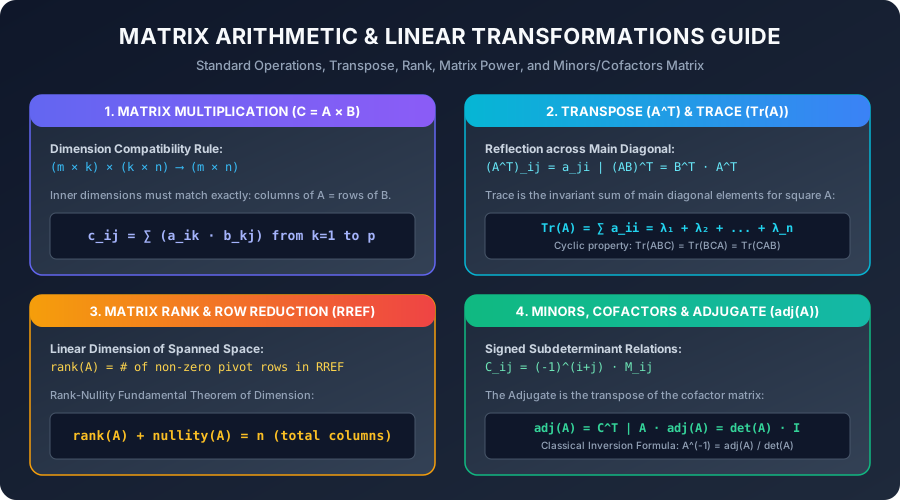
1. Matrix Multiplication as Composition of Linear Maps
In linear algebra, an m × n matrix represents a linear transformation mapping vectors from n-dimensional Euclidean space ℝⁿ into m-dimensional space ℝᵐ. When two linear transformations T_A: ℝᵖ → ℝⁿ and T_B: ℝᵐ → ℝᵖ act sequentially, the composition T_A(T_B(x)) corresponds algebraically to the matrix product AB:
c_ij = ∑ (a_ik · b_kj) from k=1 to p
Unlike real number multiplication, matrix multiplication is strictly non-commutative (AB ≠ BA in general). Furthermore, the product of two non-zero matrices can yield the zero matrix (zero divisors exist), which precludes direct division and necessitates matrix inversion via determinants and adjugate matrices.
2. Matrix Rank, Pivots, and the Fundamental Theorem of Dimension
The rank of a matrix A, denoted rank(A), is the maximum number of linearly independent row or column vectors. Equivalently, it is the dimension of the vector space spanned by its rows or columns.
- Row Echelon Form (REF): Obtained via Gaussian elimination using elementary row operations (row swap, row scaling, and row addition).
- Reduced Row Echelon Form (RREF): Every leading pivot entry is 1, and every pivot column contains zeros in all other entries.
- Rank-Nullity Theorem: For any linear mapping A: ℝⁿ → ℝᵐ, the sum of the dimension of its image (rank) and the dimension of its kernel (nullity) equals the total column dimension:rank(A) + nullity(A) = n
3. Minors, Signed Cofactors, and the Classical Adjugate Matrix
For any square n × n matrix A, the minor M_ij is the determinant of the (n - 1) × (n - 1) submatrix formed by deleting the i-th row and j-th column. Applying the alternating sign checkerboard (-1)^(i+j) yields the cofactor:
C_ij = (-1)^(i + j) · M_ij
The adjugate matrix adj(A) is defined as the transpose of the cofactor matrix: adj(A) = C^T. By Laplace expansion, the fundamental matrix identity holds:
A · adj(A) = adj(A) · A = det(A) · I
When det(A) ≠ 0, multiplying both sides by (1 / det(A)) produces the closed-form formula for the inverse matrix: A^(-1) = adj(A) / det(A).