Vector Arithmetic
u ± v, scalar multiplication k · v in 2D/3D
Vector u
Vector v
Vector Result
Spatial MetricVector Addition (u + v)
⟨4, 6, 7⟩
Length ||r|| = 10.05
Component-wise linear vector operation performed.
Academic Reference & Vector Mechanics
Vector Geometry: Dot, Cross & Scalar Triple Products in Euclidean Space
Geometric metric norms, Cauchy-Schwarz inequality, angular extraction, cross product pseudovectors, and spatial parallelepiped volumes.
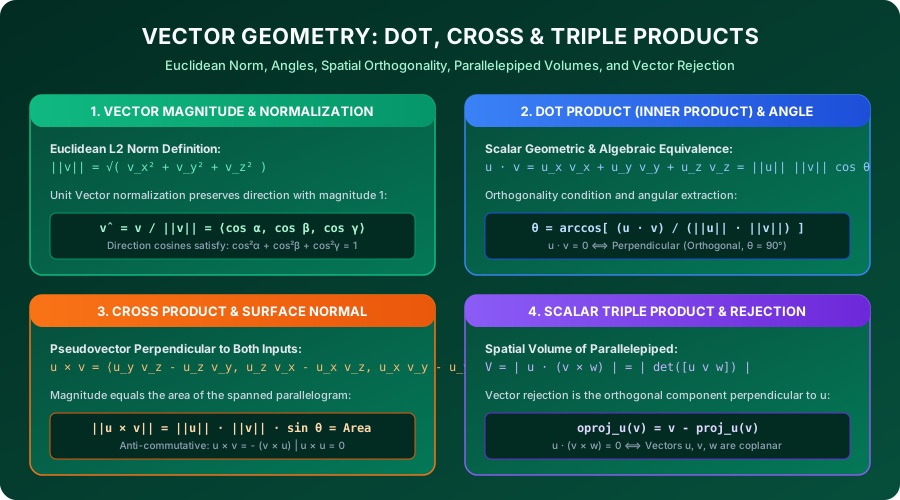
1. The Dot Product, Inner Products & Cauchy-Schwarz Inequality
The dot product (Euclidean inner product) takes two vectors u, v and returns a real scalar. Algebraically, it is the sum of component-wise products. Geometrically, it relates to the angle θ between them:
u · v = u_x v_x + u_y v_y + u_z v_z = ||u|| ||v|| cos(θ)
The fundamental Cauchy-Schwarz Inequality states that |u · v| ≤ ||u|| ||v|| for all vectors, with equality holding if and only if u and v are linearly dependent (parallel). This guarantees that the cosine ratio (u · v) / (||u|| ||v||) always resides strictly within the real interval [-1, 1], ensuring that arccos yields a well-defined angular separation.
2. The Cross Product & Right-Handed Vector Orthogonality
Unlike the dot product which exists in arbitrary dimensions, the cross product u × v is uniquely defined in 3-dimensional Euclidean space ℝ³ (and non-trivially in ℝ⁷ via octonions). It yields a pseudovector that is strictly orthogonal to both u and v:
u × v = ⟨u_y v_z - u_z v_y, u_z v_x - u_x v_z, u_x v_y - u_y v_x⟩
The magnitude ||u × v|| = ||u|| ||v|| sin(θ) equals the exact surface area of the parallelogram spanned by u and v. The cross product is anti-commutative: u × v = - (v × u). In classical physics, it models torque (τ = r × F), magnetic Lorentz force (F = q(v × B)), and angular momentum (L = r × p).
3. Scalar Triple Product & Parallelepiped Volume
The scalar triple product (also known as the box product) combines both operations: u · (v × w). It can be computed directly as the determinant of the 3×3 matrix formed by the three vectors:
u · (v × w) = det([ u v w ])
The absolute value |u · (v × w)| equals the exact spatial volume of the parallelepiped spanned by u, v, and w. If u · (v × w) = 0, the volume collapses to zero, which proves that the three vectors are coplanar (linearly dependent in 3D).