LU / QR Decomposition
Matrix factorization into triangular components
Square Matrix A (3x3)
Spectral & Algebraic Result
Exact AnalyticLU Factorization (A = L · U)
Unit Lower L
1
0
0
0.25
1
0
0.50
0
1
Upper Triangular U
4
2
1
0
4.50
1.75
0
0
5.50
L is a unit lower triangular matrix with 1s on the diagonal; U is an upper triangular matrix with Gaussian pivots.
Academic Reference & Spectral Theory
Determinants, Matrix Inverses, Cramer's Rule & Spectral Stability
Geometric scaling volume theorems, non-singularity invariants, characteristic polynomials, and numerical condition metrics.
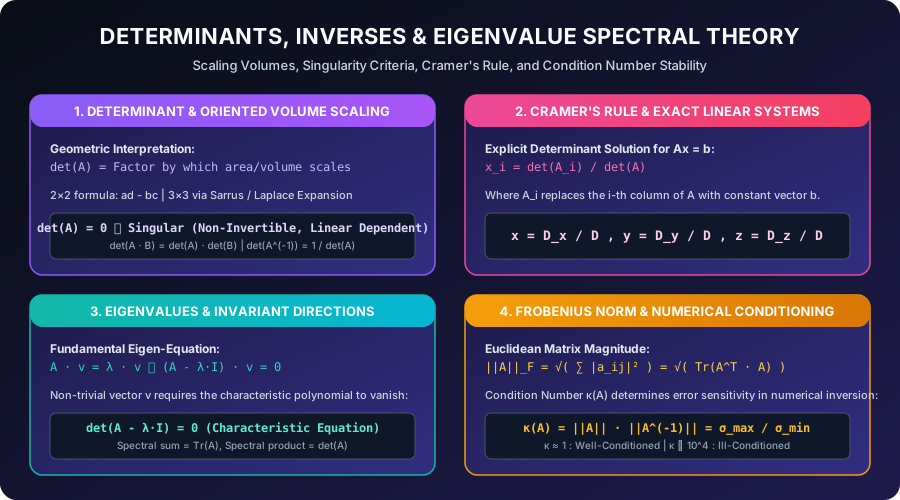
1. Determinant as Oriented Volume Scaling & Singularity
The determinant is a multilinear alternating functional that maps an n × n matrix to a real scalar. Geometrically, det(A) represents the signed hypervolume of the parallelotope spanned by the column vectors of A.
- If det(A) > 0, the transformation preserves coordinate orientation (e.g., standard right-handed Cartesian frame).
- If det(A) < 0, the transformation reverses orientation (mirror reflection combined with shear/scaling).
- If det(A) = 0, the parallelotope is flattened into lower dimensional space, having zero volume. Consequently, the matrix is singular and possesses no two-sided inverse.
2. The Characteristic Equation and Spectral Decomposition
An eigenvector v of an n × n matrix A is a non-zero vector that does not change direction when transformed by A, merely scaling by an eigenvalue λ:
Av = λv ⟺ (A - λI)v = 0
For a non-trivial vector v ≠ 0 to exist, the matrix (A - λI) must be singular, demanding that its determinant vanishes:
p(λ) = det(A - λI) = 0
This characteristic polynomial has n roots (counting algebraic multiplicity). In quantum mechanics, eigenvalues represent observable physical states (e.g. energy levels of Hamiltonians), while in data science and principal component analysis (PCA), eigenvalues quantify the variance preserved along orthogonal directions.
3. Condition Number κ(A) and Numerical Error Sensitivity
In practical computational engineering, verifying det(A) ≠ 0 is insufficient. A matrix can be theoretically non-singular but practically impossible to invert reliably on finite-precision binary floating point hardware. The condition number κ(A) quantifies this sensitivity:
κ(A) = ||A|| · ||A⁻¹|| = σ_max / σ_min
If κ(A) ≈ 1, the matrix is well-conditioned. If κ(A) > 10⁴, the matrix is ill-conditioned; solving Ax = b can lose log₁₀(κ) decimal digits of precision due to rounding, requiring Tikhonov regularization or Singular Value Decomposition (SVD) truncation.