Math Calculator
Matrices & Vectors
Row Space
Row(A) non-zero rows of RREF
Transformation Matrix A (Columns = Vectors v₁, v₂, v₃)
Subspace Solution
Exact BasisRow Space Row(A)
Dimension = 2
Basis Vectors for Subspace:
b1:⟨1, 2, 0⟩
b2:⟨0, 0, 1⟩
Dimension (Rank) = 2. Formed by the non-zero rows of the Reduced Row Echelon Form.
Academic Reference & Subspace Geometry
Vector Subspaces, Orthogonal Projections & Gram-Schmidt Orthonormalization
Gilbert Strang's 4 fundamental subspaces, orthogonal decomposition theorems, Gram-Schmidt algorithms, and least-squares plane projections.
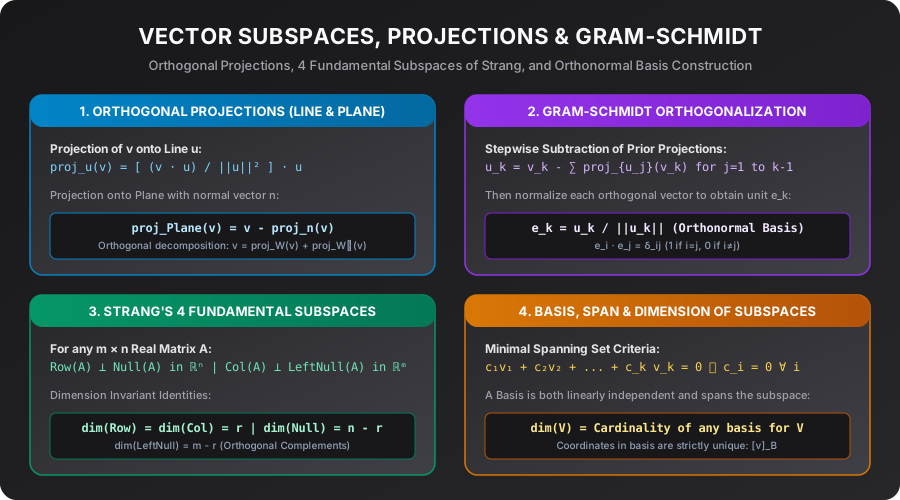
1. Orthogonal Projections onto Lines and Hyperplanes
The orthogonal projection of a vector v onto a 1-dimensional subspace spanned by a non-zero vector u is defined by minimizing the Euclidean distance ||v - cu|| over all real scalars c. Setting the derivative of the squared error to zero yields:
proj_u(v) = [ (v · u) / ||u||² ] · u
When projecting onto an arbitrary flat plane passing through the origin with normal vector n = ⟨A, B, C⟩, any vector v decomposes uniquely into a component parallel to the normal and a component parallel to the plane:
proj_Plane(v) = v - proj_n(v) = v - [ (v · n) / ||n||² ] · n
2. The Gram-Schmidt Orthonormalization Algorithm
Given a set of linearly independent vectors (v₁, v₂, ..., v_k), the Gram-Schmidt process constructs a mutually orthogonal set of vectors (u₁, u₂, ..., u_k) by iteratively subtracting the projections onto all previously constructed basis elements:
u_k = v_k - ∑ [ (v_k · u_j) / ||u_j||² ] · u_j from j=1 to k-1
Normalizing each vector e_k = u_k / ||u_k|| yields an orthonormal basis, where e_i · e_j = 1 if i = j, and 0 otherwise. This forms the mathematical foundation of the QR matrix decomposition (A = QR), where Q is an orthogonal matrix and R is upper triangular.
3. The 4 Fundamental Subspaces of Gilbert Strang
For any real m × n matrix A with rank r, linear algebra identifies four natural, canonical subspaces:
- Row Space Row(A) in ℝⁿ: Dimension r. Spanned by the rows of A (or non-zero rows of RREF).
- Null Space Null(A) in ℝⁿ: Dimension n - r. The kernel consisting of all x such that Ax = 0.
- Column Space Col(A) in ℝᵐ: Dimension r. Spanned by the columns of A (the image of the linear map).
- Left Null Space Null(Aᵀ) in ℝᵐ: Dimension m - r. The cokernel consisting of all y such that Aᵀy = 0.
The Fundamental Theorem of Linear Algebra states that Row(A) and Null(A) are orthogonal complements in ℝⁿ, and Col(A) and Null(Aᵀ) are orthogonal complements in ℝᵐ.
Frequently Asked Questions (FAQ)
About Row Space Calculator
Advanced vector subspace, orthogonal projection, and Gram-Schmidt suite. Compute projections onto lines and planes, construct orthonormal bases using the Gram-Schmidt process, and analyze the four fundamental subspaces of linear algebra (Column, Row, Null, and Left Null spaces).
Why this page helps
- Essential for linear regression least-squares, signal filtering, PCA, and quantum states
- Translates abstract linear algebra concepts into tangible coordinate solutions
- Provides exact fractions and normalized decimals for every basis vector
How to use it well
- Select your desired subspace analysis or projection tool.
- Input vector components for projection or enter the matrix column vectors.
- For plane projections, specify the plane normal coefficients A, B, and C.
- Observe the calculated projection vector, orthonormal Gram-Schmidt basis, or subspace dimension.
- Export the mathematical derivation and basis data in CSV, JSON, or TXT format.