Math Calculator
Geometry & Shapes
Circular Geometry & Ellipse Suite
Circle, Sector, Arc, Chord, Sagitta & Ellipse
Arc Length Calculator
Calculate the length of an arc.
Circular Arc Length: s = r · θ_rad
Determine the curved distance along the circumference spanned by central angle θ.
Arc Length (s)
9.4248
Curved perimeter distance
Radian Angle (θ)
0.7854
Radians (θ_deg × π / 180)
Recent Calculations
Rigorous Circular Field Manual
Complete Guide to Circles, Circular Sectors, Arcs & Ellipses
Explore circular geometry, chord mechanics, sagitta arch drafting, and Ramanujan’s elliptic integral approximations.
Figure 1: Circle, Sector, Arc & Ellipse Ecosystem
Circle anatomy, chord lengths, sagitta arch rises, and Ramanujan ellipse formulas.
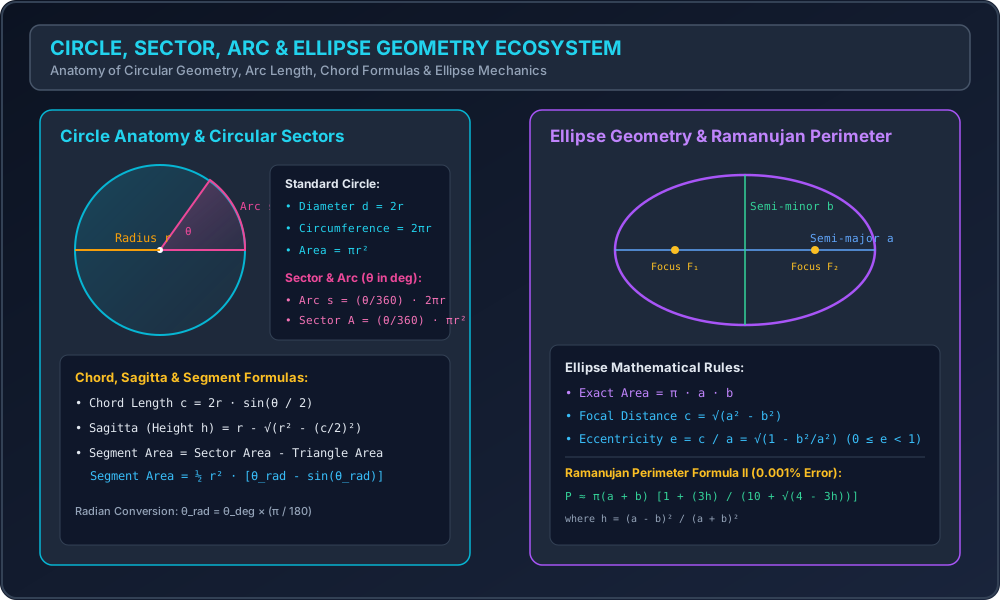
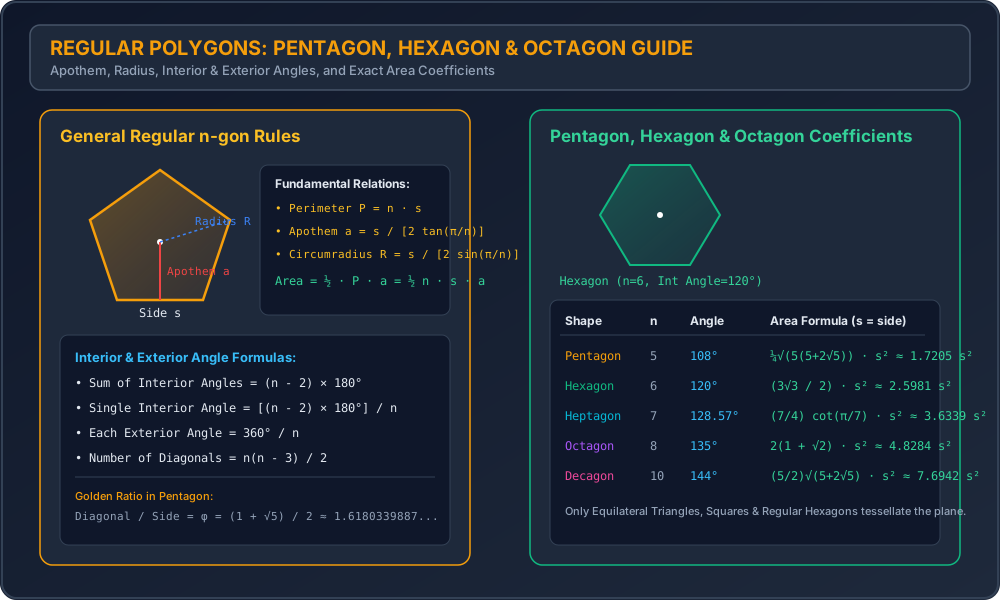
Figure 2: Regular Polygons, Apothems & Angles
Inscribed polygons, apothems, circumscribed circles, and interior angle derivations.
1. Circle Anatomy & Mathematical Proportions
A circle is defined as the locus of all coplanar points equidistant from a fixed central point. The distance from the center to any boundary point is the radius (r). The diameter (d = 2r) represents the maximum distance across the circle passing through the center. The mathematical constant π (pi ≈ 3.1415926535...) is defined fundamentally as the ratio of a circle’s circumference to its diameter: π = C / d.
Integrating concentric thin rings of circumference 2πx from x = 0 to r produces the famous area formula: Area = ∫₀ʳ (2πx) dx = πr².
2. Sectors, Arcs, Chords & Sagitta (Arch Engineering)
When a central angle θ is subtended at the center of a circle:
- Arc Length (s): Represents the fractional perimeter along the curve: s = (θ / 360°) · 2πr = r · θ_rad.
- Sector Area: Represents the wedge area enclosed by the two radii and the arc: Area = (θ / 360°) · πr² = ½ r² θ_rad.
- Chord Length (c): A straight line connecting the two endpoints of the arc: c = 2r · sin(θ / 2).
- Sagitta (Height h): In masonry bridge arches and optical lenses, the sagitta represents the maximum perpendicular rise from the midpoint of the chord to the arc: h = r - √(r² - (c/2)²).
3. Ellipse Mechanics & Ramanujan's Perimeter Formulations
An ellipse is the locus of all points whose sum of distances from two focal points (F₁ and F₂) is constant (equal to 2a). While the area of an ellipse is exact and elegant (Area = π · a · b), its perimeter cannot be expressed in terms of elementary functions because it requires a complete elliptic integral of the second kind.
In 1914, the legendary Indian mathematician Srinivasa Ramanujan published his famous approximation:
P ≈ π(a + b) [1 + (3h) / (10 + √(4 - 3h))]
where h = (a - b)² / (a + b)². Ramanujan's formula provides sub-0.001% accuracy for virtually all elliptical eccentricities, making it the industrial standard in satellite orbit mechanics and aerospace propellant tank engineering.
Frequently Asked Questions
About Arc Length Calculator
Comprehensive circular geometry calculator suite. Solve circle dimensions, sector areas, arc lengths, chord lengths, sagitta arch rises, and ellipse Ramanujan perimeters.
Why this page helps
- Crucial for civil engineering (bridge arches, roundabouts), mechanical gearing, and astronomy
- Provides exact formulas alongside high-precision floating-point decimal results
- Includes interactive zero-blur vector diagrams showing circular anatomy
How to use it well
- Choose your circular mode: Circle (Radius, Diameter, Area, Circumference), Sector Area, Arc Length, Chord & Sagitta, or Ellipse.
- Enter radius, central angle θ in degrees, or ellipse semi-axes a and b.
- View high-precision area, perimeter, chord lengths, and arch heights.
- Export your circular geometry report to PDF or copy the formatted derivations.
Expert tips
- When calculating sectors and arcs, verify whether your angle is in degrees or radians. In radians, s = rθ and A = ½r²θ.