Triangle & Pythagorean Suite
Pythagoras, Heron's, SAS & Equilateral
Pythagorean Theorem Calculator
Calculate right triangle sides.
Pythagorean Theorem: a² + b² = c²
Solve right triangles for the hypotenuse or either perpendicular leg.
Hypotenuse (c):
5.0000
Integer Triple
c = √(3² + 4²) = √(25) = 5.0000
Right Triangle Area: 6.00Perimeter: 12.00
Recent Calculations
Rigorous Trigonometric Field Manual
Complete Guide to Triangle Trigonometry & the Pythagorean Theorem
Master right-triangle solving, Heron’s formula, the Law of Cosines, and integer Pythagorean triples.
Figure 1: Triangle Geometry & Pythagorean Theorem
Right triangles, hypotenuse solvers, Heron's formula, and integer Pythagorean triples.
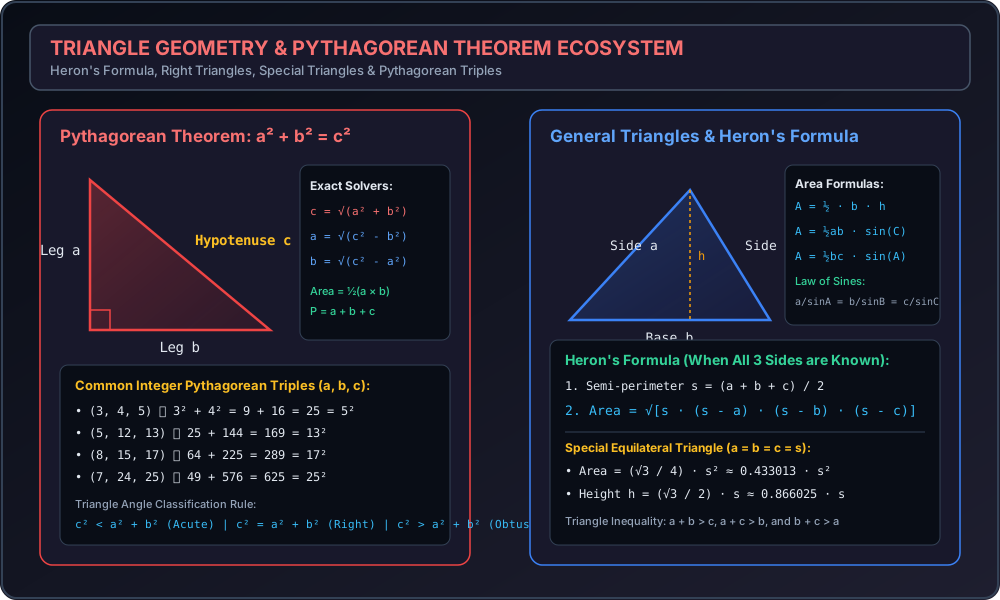
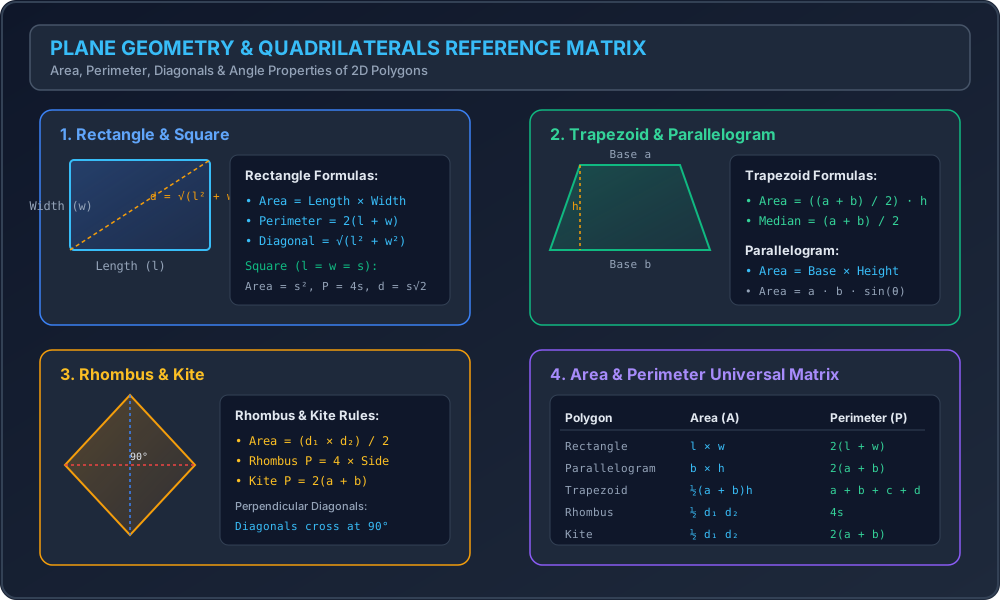
Figure 2: Plane Geometry & 2D Polygons Matrix
Perpendicular diagonal cross-sections, trapezoid medians, and area formulations.
1. The Pythagorean Theorem: Foundations & Geometric Proof
The Pythagorean theorem is one of the most fundamental principles in Euclidean geometry. It states that in any right-angled triangle, the area of the square whose side is the hypotenuse (c) is equal to the sum of the areas of the squares on the other two legs (a and b): a² + b² = c². This geometric truth can be visually demonstrated by arranging four congruent right triangles inside a larger square of side (a + b), where the unshaded central diamond has an area of c², perfectly balancing a² + b².
Beyond right triangles, the theorem enables angle classification: for any triangle with sides a ≤ b ≤ c:
- Acute Triangle: c² < a² + b² (All interior angles < 90°)
- Right Triangle: c² = a² + b² (Exactly one 90° angle)
- Obtuse Triangle: c² > a² + b² (One angle > 90°)
2. Heron's Formula for Arbitrary Scalene Triangles
When a triangle’s vertical altitude is difficult to measure directly (such as in land topography or irregular civil plots), Heron of Alexandria’s formula provides the exact area using only the three boundary side lengths (a, b, c):
Area = √[s · (s - a) · (s - b) · (s - c)]
Here, s = (a + b + c) / 2 represents the semi-perimeter. For Heron’s formula to produce a valid real result, the side lengths must satisfy the Triangle Inequality Theorem: the sum of the lengths of any two sides must be strictly greater than the third side (a + b > c, a + c > b, and b + c > a). If this condition fails, the three segments cannot connect in Euclidean space.
3. Trigonometric Area (SAS) & the Law of Cosines
When surveying angles using a theodolite or total station, the Side-Angle-Side (SAS) configuration is common. If sides a and b meet at an angle θ, the perpendicular height is simply h = a · sin(θ), yielding the area formula: Area = ½ · a · b · sin(θ).
Furthermore, the Law of Cosines extends the Pythagorean theorem to any arbitrary triangle: c² = a² + b² - 2ab · cos(θ). When θ = 90°, cos(90°) = 0, and the formula simplifies identically to the classical Pythagorean equation.