Regular Polygons & Angles Suite
General n-gon, Pentagon, Hexagon & Octagon
Octagon Calculator
Calculate properties of an octagon.
Regular Octagon (n = 8): Area = 2(1 + √2)s²
Classic stop-sign shape. Interior angles equal 135°.
Area
309.02
2(1 + √2) · s²
Apothem
9.66
((1 + √2) / 2) · s
Perimeter
64.00
8s
Recent Calculations
Rigorous Regular Polygon Manual
Complete Guide to Regular Polygons, Apothems & Tessellation
Explore n-gon geometric symmetry, interior angle derivations, the golden ratio in pentagons, and honeycomb efficiency.
Figure 1: Regular Polygons, Apothems & Angles
Inscribed polygons, apothems, circumscribed circles, and interior angle derivations.
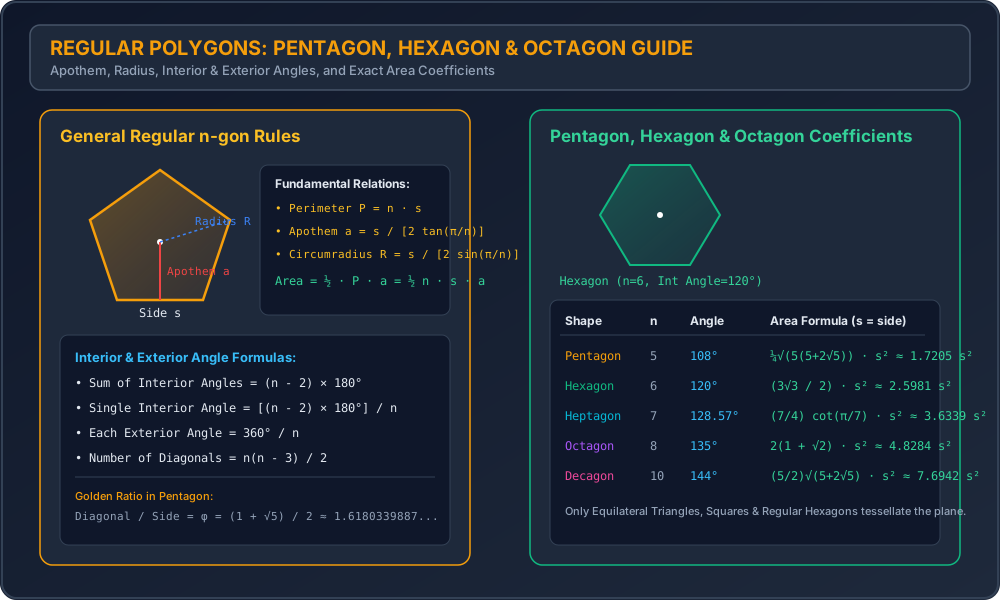
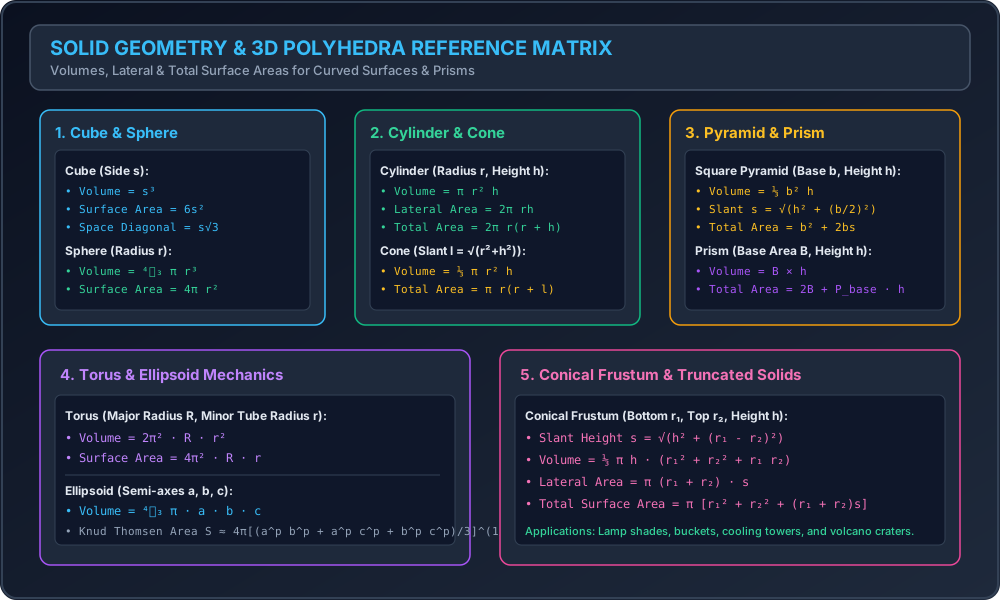
Figure 2: Solid Geometry & 3D Polyhedra
Volume, lateral area, total surface area, and slant heights for 3D curved surfaces and polyhedra.
1. What Defines a Regular Polygon?
A polygon is classified as regular if and only if it is both equilateral (all sides have identical length) and equiangular (all interior angles are identical). The perimeter of a regular n-gon is simply P = n × s. Every regular polygon possesses both an inscribed circle (incircle) tangent to the midpoint of all sides, and a circumscribed circle (circumcircle) passing through all vertices.
2. The Apothem & Fundamental Area Derivation
The apothem (denoted a) is the perpendicular line segment drawn from the central origin of the polygon to the midpoint of any outer side. It serves as the inradius of the incircle. By connecting the center to all n vertices, the polygon is partitioned into n congruent isosceles triangles, each having base s and altitude a. Summing their areas yields:
Area = n · (½ · s · a) = ½ · (n · s) · a = ½ · Perimeter · Apothem
Using trigonometry on the right triangle formed by half a side, the apothem is computed as a = s / [2 · tan(π / n)].
3. Planar Tessellation & the Honeycomb Theorem
A regular tessellation is a pattern made by repeating a single regular polygon over a flat 2D plane with zero gaps and zero overlaps. For a regular polygon to tessellate, its interior angle must divide 360° evenly. Because the interior angle is [(n - 2) × 180°] / n, the only integer solutions are:
- Equilateral Triangles (n = 3): Angle = 60° (6 triangles meet at each vertex: 6 × 60° = 360°).
- Squares (n = 4): Angle = 90° (4 squares meet at each vertex: 4 × 90° = 360°).
- Regular Hexagons (n = 6): Angle = 120° (3 hexagons meet at each vertex: 3 × 120° = 360°).
No other regular polygon can tile the plane. Proved mathematically by Thomas Hales in 1999, the Honeycomb Theorem demonstrates that a hexagonal grid provides the absolute minimal perimeter required to enclose equal areas, explaining why honeybees build hexagonal wax comb cells to maximize honey storage while minimizing beeswax expenditure.