3D Solid Geometry Suite
Volumes, Lateral & Total Surface Areas
Surface Area Calculator
Calculate surface area of 3D objects.
Cylinder Volume (π r² h) & Surface Areas
Enter base radius (r) and vertical height (h).
Volume (π r² h)
502.65
Cubic capacity
Lateral Area (2π rh)
251.33
Curved wall area
Total Surface Area
351.86
2π r(r + h)
Recent Calculations
Rigorous Solid Geometry Manual
Complete Guide to Solid Geometry, 3D Polyhedra & Curvature
Explore Archimedean principles, prismoidal integration, surface area minimalization, and industrial capacity estimations.
Figure 1: Solid Geometry & 3D Polyhedra Reference
Volumes, lateral areas, total surface areas, and slant height formulations.
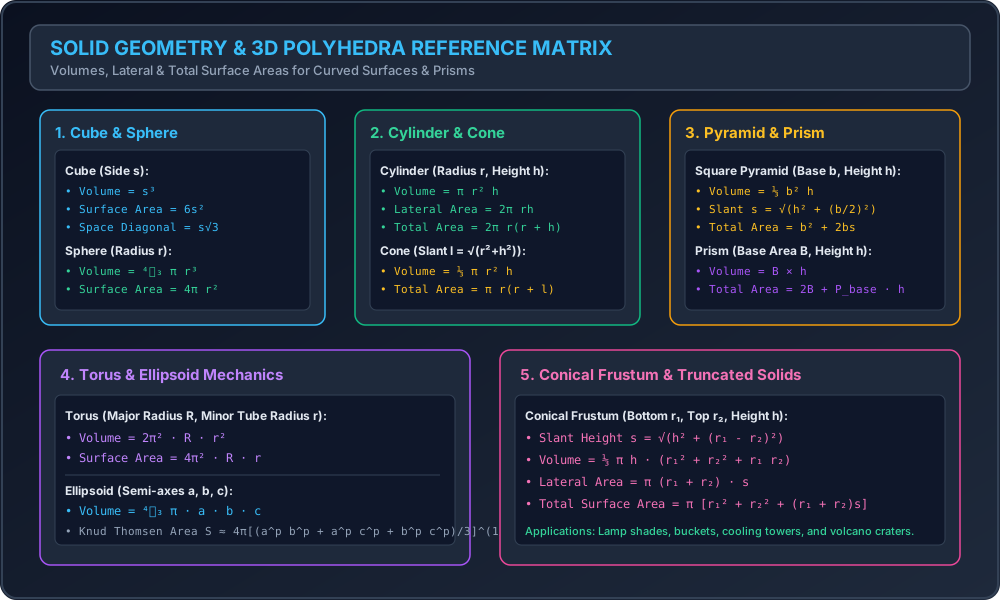
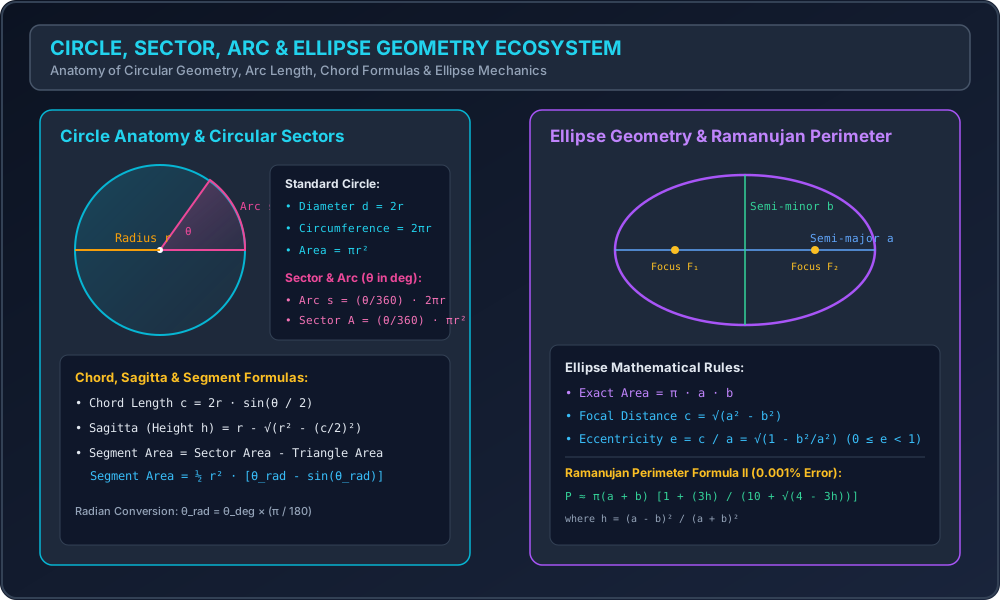
Figure 2: Circle Theorems, Arcs & Circular Sectors
Circle anatomy, chord lengths, sagitta arch rises, and Ramanujan ellipse formulas.
1. The Calculus of 3D Curved Solids: Archimedes' Revelation
Archimedes considered his greatest mathematical achievement to be discovering the precise ratio between a sphere and a circumscribed cylinder of identical radius r and height h = 2r. Both the volume and surface area of the sphere are exactly two-thirds (⅔) of the cylinder:
V_sphere = ⁴⁄₃ π r³ = ⅔ · (π r² · 2r) = ⅔ · V_cylinder
Similarly, a right circular cone sharing the same base and height possesses exactly one-third (⅓) the volume of the cylinder: V_cone = ⅓ π r² h. Together, Cone, Sphere, and Cylinder maintain the famous Archimedean proportion 1 : 2 : 3.
2. The Torus & Pappus's Centroid Theorem
A torus is formed by revolving a circle of radius r around an axis coplanar with the circle at a distance R > r from its center. According to Pappus's Centroid Theorem:
- Volume: Equal to the area of the generating shape multiplied by the distance traveled by its geometric centroid during revolution: V = (π r²) × (2π R) = 2π² R r².
- Surface Area: Equal to the perimeter of the generating circle multiplied by the distance traveled by its centroid: Area = (2π r) × (2π R) = 4π² R r.
3. The Prismoidal Formula for Civil Engineering & Excavations
For truncated solids like the conical frustum or earthwork railway cuttings with non-parallel sloped side walls, Simpson’s prismoidal rule provides exact volumetric integration:
Volume = (h / 6) · [A_top + 4 · A_mid + A_bottom]
In mining, hopper design, and reservoir construction, using the true frustum formula eliminates costly volumetric overestimation errors inherent in simple average-end-area approximations.