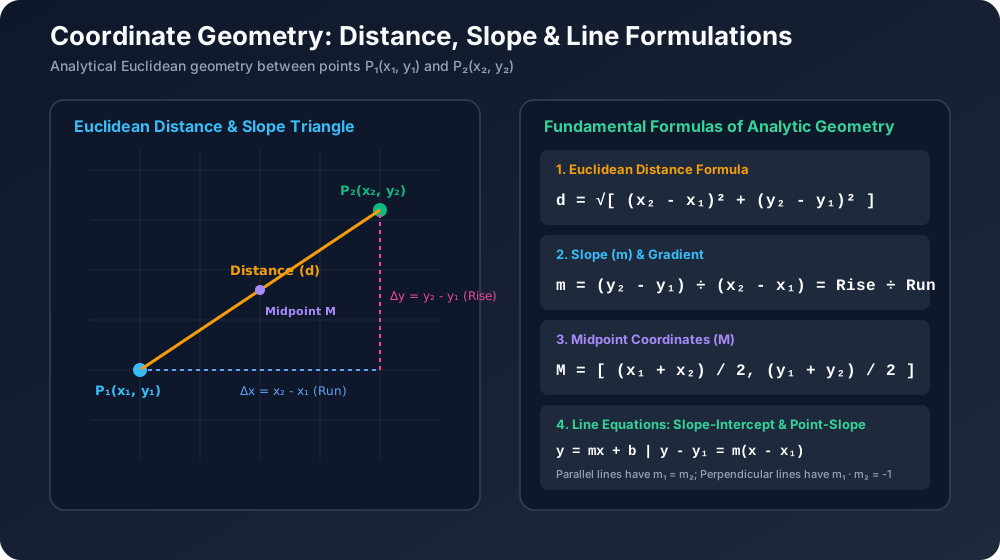
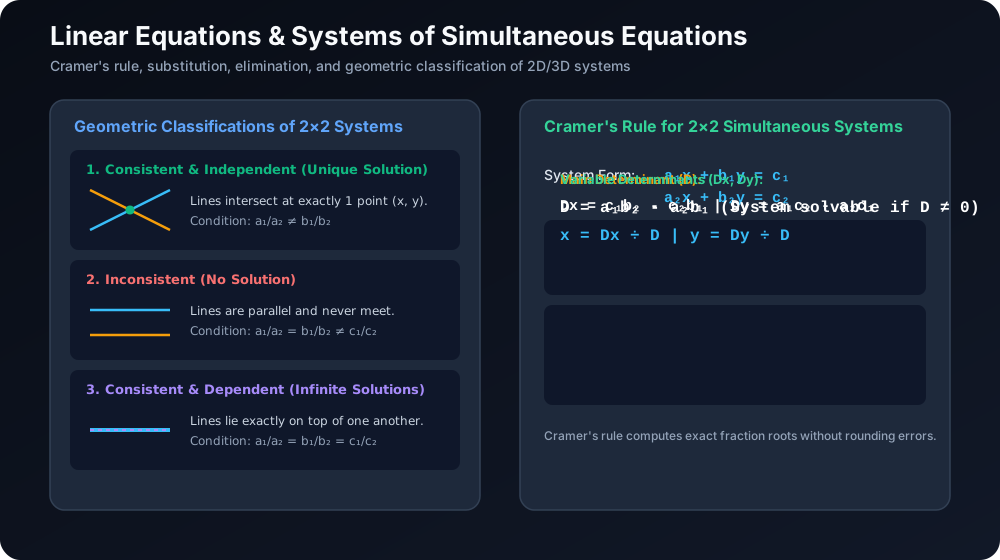
Authoritative reference charts illustrating Cartesian distance triangles, slope rise/run, and line equation models.
Distance Triangle & Midpoint Geometry
Euclidean distance derivation via Pythagorean hypotenuse, horizontal run (Δx), and vertical rise (Δy).
Lines & Simultaneous Intersections
Geometric intersection classifications: unique solution, parallel non-intersecting, and coincident lines.
Comprehensive Reference: Analytic Coordinate Geometry and Linear Formulations
Analytic geometry fuses algebra with Euclidean geometry, representing points as coordinate ordered pairs $(x, y)$ and equations as curves on a Cartesian plane.
1. Derivation of the Distance Formula from the Pythagorean Theorem
Connecting any two points $P_1(x_1, y_1)$ and $P_2(x_2, y_2)$ forms a right-angled triangle with legs of length $|x_2 - x_1|$ and $|y_2 - y_1|$. By the Pythagorean Theorem:
d² = (Δx)² + (Δy)² = (x₂ - x₁)² + (y₂ - y₁)²
Taking the principal non-negative square root yields the celebrated Euclidean distance formula d = √((x₂ - x₁)² + (y₂ - y₁)²).
Frequently Asked Questions (FAQ)
About Distance Calculator
Find distance between two points. Designed for fast, accurate calculation with clear outputs, explanation, and device-friendly usability.
Why this page helps
Fast answers without manual formula rearrangement
Cleaner comparison of multiple scenarios
Works on mobile, tablet, and desktop
Useful for study, planning, and quick verification
How to use it well
Open the Distance Calculator and enter the known input values.
Select the correct units for each field before calculating.
Review the main result, formula, and conversions shown on the page.
Use the step-by-step breakdown to verify the logic and download or share the result if needed.
Expert tips
Check that all inputs use the correct unit system before comparing values.
Use the worked steps to confirm whether you entered the right known variables.
Math Calculator
Geometry & Shapes
Analytic Coordinate Geometry Suite
Euclidean Plane & Slope Intercept
Distance Calculator
Find distance between two points.
Euclidean Distance Calculator
Calculate the exact straight-line geometric distance between two coordinate points P₁(x₁, y₁) and P₂(x₂, y₂).
Authoritative reference charts illustrating Cartesian distance triangles, slope rise/run, and line equation models.
Distance Triangle & Midpoint Geometry
Euclidean distance derivation via Pythagorean hypotenuse, horizontal run (Δx), and vertical rise (Δy).
Lines & Simultaneous Intersections
Geometric intersection classifications: unique solution, parallel non-intersecting, and coincident lines.
Comprehensive Reference: Analytic Coordinate Geometry and Linear Formulations
Analytic geometry fuses algebra with Euclidean geometry, representing points as coordinate ordered pairs $(x, y)$ and equations as curves on a Cartesian plane.
1. Derivation of the Distance Formula from the Pythagorean Theorem
Connecting any two points $P_1(x_1, y_1)$ and $P_2(x_2, y_2)$ forms a right-angled triangle with legs of length $|x_2 - x_1|$ and $|y_2 - y_1|$. By the Pythagorean Theorem:
d² = (Δx)² + (Δy)² = (x₂ - x₁)² + (y₂ - y₁)²
Taking the principal non-negative square root yields the celebrated Euclidean distance formula d = √((x₂ - x₁)² + (y₂ - y₁)²).
Frequently Asked Questions (FAQ)
About Distance Calculator
Find distance between two points. Designed for fast, accurate calculation with clear outputs, explanation, and device-friendly usability.
Why this page helps
Fast answers without manual formula rearrangement
Cleaner comparison of multiple scenarios
Works on mobile, tablet, and desktop
Useful for study, planning, and quick verification
How to use it well
Open the Distance Calculator and enter the known input values.
Select the correct units for each field before calculating.
Review the main result, formula, and conversions shown on the page.
Use the step-by-step breakdown to verify the logic and download or share the result if needed.
Expert tips
Check that all inputs use the correct unit system before comparing values.
Use the worked steps to confirm whether you entered the right known variables.
If the result looks unrealistic, re-check sign convention, rounding, and assumptions.