Physics Calculator
Mechanics & Motion
Classical Mechanics•Rotational Dynamics & Circular Motion
Angular Velocity Calculator
Comprehensive institutional physics suite for calculating rotational moments (\(\tau = r F \sin \theta\)), multi-geometry moments of inertia (\(I\)), centripetal forces & banked highway curves (\(F_c = m v^2 / r\)), and angular kinematics (\(\omega, \alpha, \theta\)).
Torque Lever Parameters
0.5 m
N
90°
0° (Parallel, Zero Torque)90° (Maximum Efficiency)180° (Zero Torque)
RPM
Torque & Power Output
τ = r · F · sin(θ)Torque (SI Metric)
60
Newton-meters (N·m)
Torque (Imperial)
44.25
Foot-pounds (ft·lb)
Mechanical Power
12.64
Horsepower (9424.8 W)
Perpendicular Force
120 N
F·sin(θ) (Useful Moment)
Radial Force (Stress)
0 N
F·cos(θ) (Bearing Tension)
Work Per Revolution
376.99 J
W = 2π · τ (Joules/rev)
Torque vs Power Relationship:
Torque represents the rotational turning effort, while power measures the rate at which torque performs work over time (\(P = \tau \cdot \omega\)). In automotive and industrial engineering, a 500 N·m diesel engine produces low horsepower at 2,000 RPM (~140 hp), while a 300 N·m Formula 1 engine spinning at 15,000 RPM generates over 630 hp.
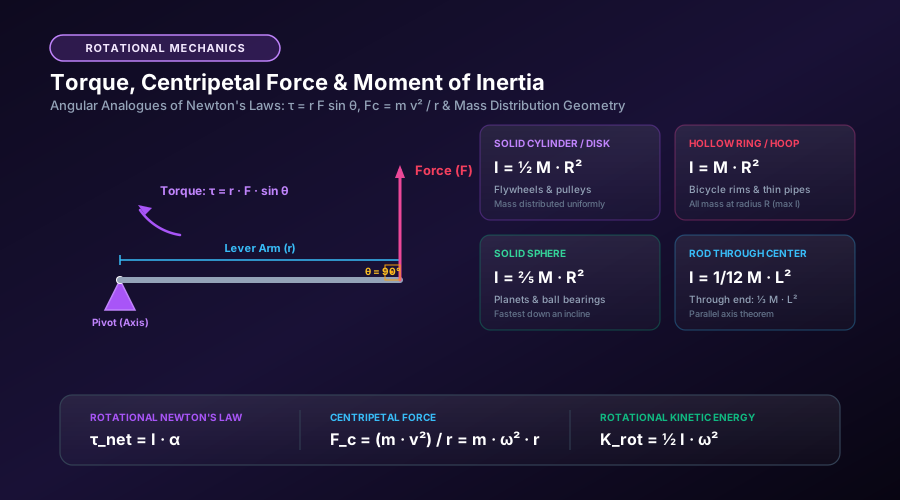
Rotational Mechanics: Torque & Moment of Inertia
Lever arm geometry: Cross product \(\tau = r \times F\), angular acceleration \(\tau = I \alpha\), and mass distribution moments.
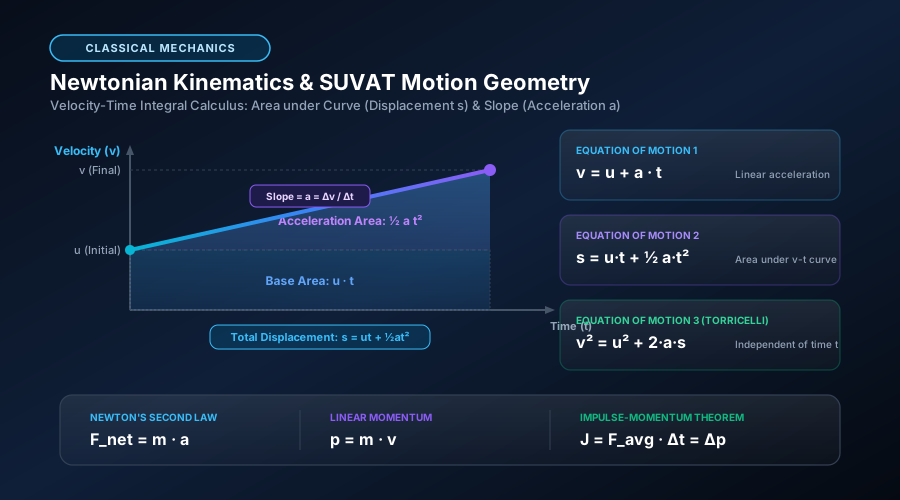
Linear & Angular Vector Kinematics
Concordance of differential motion: Linear displacement and velocity mapped to angular displacement \(\theta\) and rotation rate \(\omega\).
Rotational Dynamics & Circular Motion: The Physics of Angular Acceleration, Torque & Gyration
Rotational mechanics governs physical systems constrained to rotate about fixed or moving axes. By applying mathematical transformations to Newton's laws of linear motion, rotational physics establishes exact analogues for mass (moment of inertia), force (torque), momentum (angular momentum), and acceleration (angular acceleration).
1. Torque, Lever Arms & Vector Cross Products
Torque (τ), or the moment of force, measures the rotational effectiveness of a force applied at a displacement vector r from a pivot axis. In vector notation:
τ = r × F ⟹ |τ| = r · F · sin(θ)
where θ is the angle between the lever arm vector r and force vector F. The perpendicular component F_perp = F·sin(θ) produces rotation, whereas the parallel component F_parallel = F·cos(θ) generates radial compressive or tensile stress on the axle bearings without contributing to torque.
2. Moment of Inertia & The Parallel Axis Theorem
In linear motion, an object's mass m provides invariant resistance to acceleration (F = m·a). In rotation, however, resistance to angular acceleration depends not merely on total mass, but fundamentally on how that mass is geometrically distributed relative to the axis of rotation:
I = ∫ r² dm = Σ m_i · r_i²
Because every incremental mass element is weighted by the square of its radius (r²), shifting mass outward drastically amplifies rotational resistance.
When an object rotates about an arbitrary axis parallel to an axis passing through its center of mass, the Huygens-Steiner Parallel Axis Theorem states:
I_parallel = I_cm + M · d²
where d is the perpendicular distance between the two parallel axes. This theorem allows engineers to swiftly calculate the rotational inertia of off-center flywheels, engine crankshafts, and robotic articulation linkages.
3. Centripetal Force, Banking Angles & Orbital Curvature
An object executing uniform circular motion travels at constant speed v, but its velocity vector continuously alters direction toward the center of curvature. According to Newton's First Law, this directional change requires a net inward centripetal acceleration:
a_c = v² / r = ω² · r
The corresponding required centripetal force is Fc = m·ac = (m·v²) / r.
On banked roadways or aircraft banking maneuvers, the normal lift or pavement force Fn provides the inward centripetal force without relying on tire friction:
Fn · sin(θ) = (m·v²) / r, Fn · cos(θ) = mg ⟹ tan(θ_ideal) = v² / (g·r)
This optimal banking angle ensures that lateral tire shear forces vanish entirely at the design velocity.
Frequently Asked Questions
Why does an ice skater spin faster when pulling their arms inward?
Because no external net torque acts on the skater, total angular momentum is conserved (L = I · ω = constant). Bringing their arms inward reduces their moment of inertia I (since radius r decreases), forcing their angular velocity ω to increase proportionally.
Is centrifugal force a real physical force?
In an inertial (non-accelerating) reference frame, centrifugal force does not exist; only the real inward centripetal force is acting. However, from the perspective of an observer inside the rotating reference frame (e.g., inside a turning car), the outward centrifugal force is perceived as an apparent or fictitious inertial force arising from the observer's own accelerated frame.
What is the difference between tangential and centripetal acceleration?
Tangential acceleration (at = α · r) acts along the direction of motion, changing the magnitude of speed (speeding up or slowing down the rotation). Centripetal acceleration (ac = v² / r) acts perpendicularly inward toward the axis, changing only the direction of the velocity vector.
About Angular Velocity Calculator
Calculate angular speed. Built for fast physics problem solving with step-by-step explanations, unit conversions, and practical help content.
Why this page helps
- Better than a plain formula page because it explains the result as well as calculates it
- Useful for school, college, exam practice, and quick engineering checks
- Helps reduce common unit-conversion mistakes
- Makes scenario testing faster with presets and instant recalculation
How to use it well
- Choose the Angular Velocity Calculator and identify which motion values are already known.
- Enter the values carefully and set the matching units for distance, time, velocity, angle, or acceleration.
- Read the main answer first, then confirm the formula and the step-by-step derivation.
- Use the conversion output, graph, related tools, or download options if you need a report or comparison.