Physics Calculator
Mechanics & Motion
Kinematic Velocity Inputs
Linear Velocity Result
22.22m/s
Equivalent to 80 km/h (49.71 mph)
Miles Per Hour49.71mph
Kilometers/Hour80km/h
Nautical Knots43.2knots
Mach SpeedMach 0.065@343 m/s air
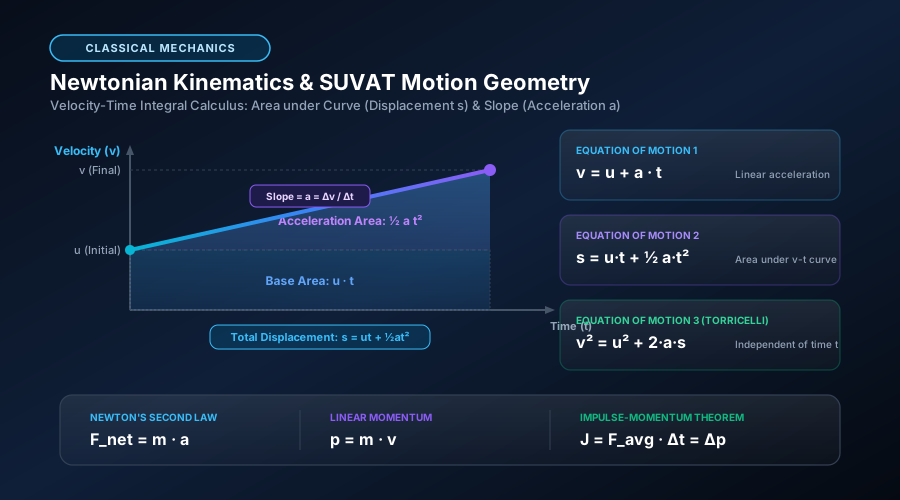
Newtonian Kinematics & SUVAT Motion Geometry
Velocity-time integral calculus: Displacement s as area under the curve, acceleration a as slope, and Newton's second law vector relations.
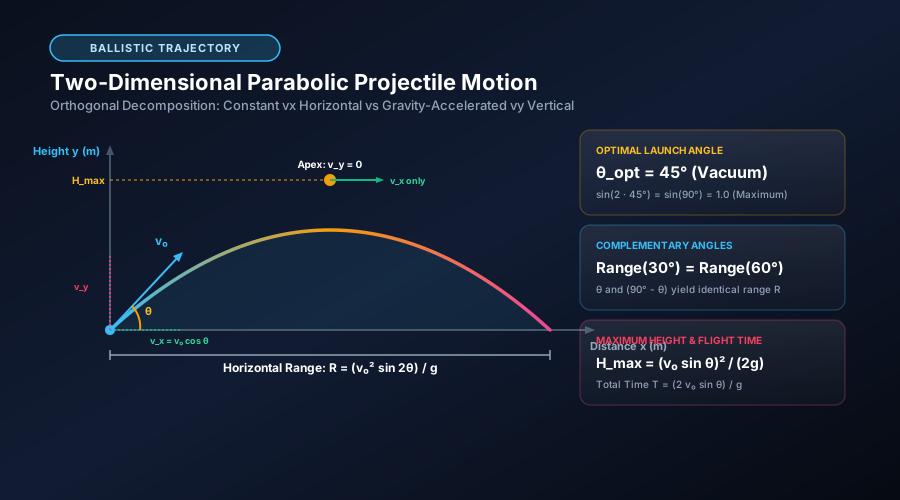
Two-Dimensional Parabolic Projectile Motion
Independent orthogonal vector decomposition: Constant horizontal velocity vx vs gravity-accelerated vertical velocity vy.
Classical Newtonian Mechanics: The Vector Foundations of Motion & Momentum
Formulated by Sir Isaac Newton in his 1687 masterwork Philosophiae Naturalis Principia Mathematica, classical mechanics models the deterministic behavior of macroscopic physical systems. By analyzing displacement, velocity, acceleration, force, and momentum, engineering physics predicts the trajectories of vehicles, structural loads, aerospace orbits, and mechanical engines.
1. The Constant Acceleration Equations of Motion (SUVAT)
When an object moves under a constant net acceleration a, its motion is fully described by five kinematic variables: displacement (s), initial velocity (u), final velocity (v), acceleration (a), and time elapsed (t):
- Velocity Equation: v = u + a·t (derived directly from the definition of acceleration a = dv/dt).
- Displacement Integral: s = u·t + ½·a·t² (representing the geometric area beneath the linear velocity-time graph).
- Torricelli's Timeless Equation: v² = u² + 2·a·s (derived by eliminating time t, directly expressing the work-energy theorem).
- Average Velocity Form: s = ((u + v) / 2) · t.
2. Newton's Second Law & The Concept of Net Force
Newton's Second Law states that the time rate of change of an object's linear momentum is directly proportional to the applied net force:
F_net = dp/dt = d(mv)/dt = m · a (for constant mass m)
Force is a vector quantity possessing magnitude and direction. One Newton (N) is defined as the force required to accelerate a 1-kilogram mass at a rate of 1 meter per second squared (1 N = 1 kg·m/s²).
3. Conservation of Momentum & Collision Mechanics
In an isolated system devoid of external net forces, total linear momentum p = mv remains rigorously conserved:
Σ p_initial = Σ p_final ⟹ m₁·u₁ + m₂·u₂ = m₁·v₁ + m₂·v₂
Collisions are categorized according to kinetic energy preservation:
- Elastic Collisions: Both momentum and total kinetic energy are conserved (ΔK = 0). Common at atomic scales.
- Inelastic Collisions: Momentum is conserved, but kinetic energy is partially converted into internal thermal energy, sound, and structural deformation.
- Perfectly Inelastic Collisions: The colliding bodies coalesce and move with a single common final velocity vf = (m₁·u₁ + m₂·u₂) / (m₁ + m₂), resulting in the maximum possible loss of macroscopic kinetic energy.
Frequently Asked Questions
What is the difference between speed and velocity?
Speed is a scalar quantity measuring the magnitude of distance covered over time. Velocity is a vector quantity combining speed with directional displacement.
Why can't an object exceed the speed of light?
In Einstein's special relativity, as an object with mass accelerates toward \(c\), its relativistic momentum grows asymptotically toward infinity. Accelerating a massive particle to \(c\) requires infinite work and energy.
What is the de Broglie wavelength of a macroscopic object?
According to wave-particle duality, all matter has an associated wavelength \(\lambda = h / p\). For a 1,500 kg car traveling at 20 m/s, \(\lambda \approx 2.2 \times 10^-38\) meters—infinitesimally smaller than an atomic nucleus, rendering quantum interference undetectable.
About Distance Calculator
Calculate motion distance using speed, time, and acceleration. Built for fast physics problem solving with step-by-step explanations, unit conversions, and practical help content.
Why this page helps
- Better than a plain formula page because it explains the result as well as calculates it
- Useful for school, college, exam practice, and quick engineering checks
- Helps reduce common unit-conversion mistakes
- Makes scenario testing faster with presets and instant recalculation
How to use it well
- Choose the Distance Calculator and identify which motion values are already known.
- Enter the values carefully and set the matching units for distance, time, velocity, angle, or acceleration.
- Read the main answer first, then confirm the formula and the step-by-step derivation.
- Use the conversion output, graph, related tools, or download options if you need a report or comparison.