Physics Calculator
Mechanics & Motion
Classical Mechanics•Ballistics, Drag & Gravitational Dynamics
Free Fall Calculator
Multi-mode institutional computational physics engine simulating 2D parabolic ballistic trajectories, atmospheric drag & terminal velocity free fall, static/kinetic tribological friction on inclined planes, and Newton's inverse-square universal gravitation.
Launch Parameters
35 m/s
45°
0° (Flat Horizontal)45° (Max Vacuum Range)89° (Near Vertical)
m
kg
Ballistic Trajectory Metrics
g = 9.80665 m/s²Total Horizontal Range
124.93
meters (409.9 ft)
Maximum Apex Height
31.22
meters (102.4 ft)
Total Time of Flight
5.05
seconds (Apex @ 2.52s)
Impact Velocity
35 m/s
126.0 km/h
Impact Angle
45°
relative to horizontal
Initial Kinetic Energy
1531.25 J
Impact: 1531.25 J
Key Trajectory Coordinates (x, y, v)
| Time (s) | X Dist (m) | Y Height (m) | Vx (m/s) | Vy (m/s) | V Total (m/s) |
|---|
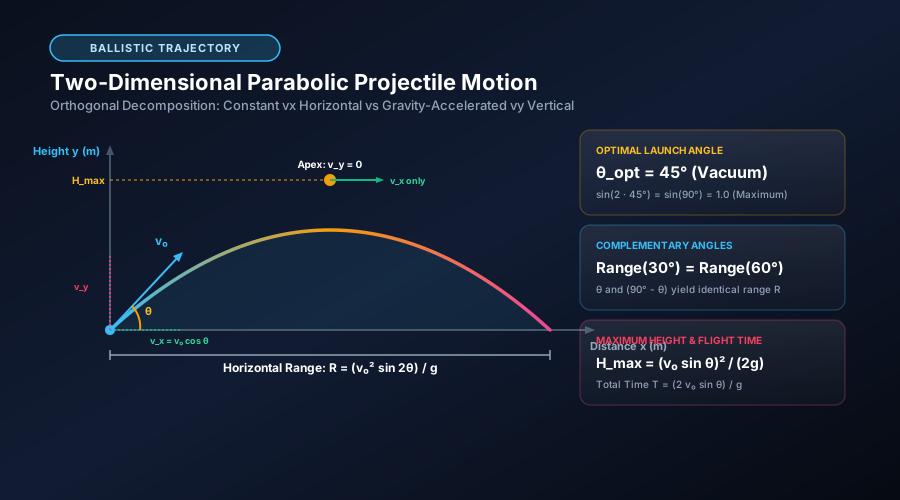
Two-Dimensional Parabolic Ballistic Trajectories
Orthogonal vector independence: Uniform horizontal velocity vx with constant gravitational vertical acceleration -g, establishing the classic Galileo parabola.
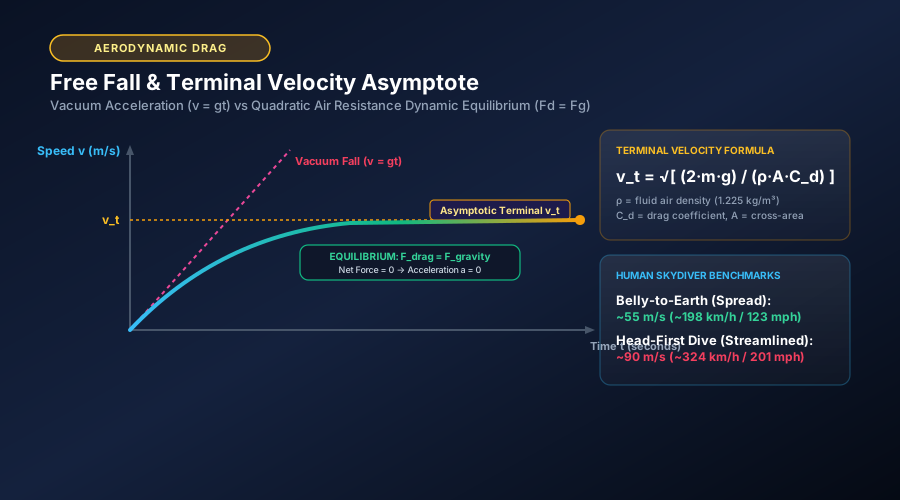
Atmospheric Free Fall & Terminal Velocity Asymptote
Quadratic aerodynamic drag curve: Velocity-dependent air resistance equilibrates with gravitational force mg, asymptotically capping descent velocity at vt.
Ballistics, Aerodynamic Drag & Gravitational Dynamics: The Physics of Atmospheric & Orbital Flight
Ballistics and orbital mechanics represent two regimes of the same fundamental physics: the motion of bodies accelerated by gravitation and resisted by fluid friction. From the launch of artillery shells and sports balls to atmospheric skydiving and satellite orbital mechanics, precise predictive modeling requires synthesizing Galileo's parabolic vector kinematics with Newton's universal law of gravitation and fluid drag equations.
1. Two-Dimensional Projectile Motion & Vector Orthogonality
In 1638, Galileo Galilei published his groundbreaking discovery that projectile motion is composed of two independent, simultaneous motions:
- Horizontal Dimension (X-axis): In the absence of atmospheric drag, no horizontal force acts on the projectile (Fx = 0). Thus, the horizontal velocity remains perfectly constant: vx(t) = v₀·cos(θ) and horizontal displacement grows linearly: x(t) = (v₀·cos(θ))·t.
- Vertical Dimension (Y-axis): Gravity exerts a constant downward acceleration ay = -g. The vertical velocity diminishes linearly: vy(t) = v₀·sin(θ) - g·t, and the altitude follows the quadratic integral: y(t) = h₀ + (v₀·sin(θ))·t - ½·g·t².
Combining these equations by eliminating time t yields the classic parabolic trajectory equation:
y(x) = h₀ + x·tan(θ) - (g·x²) / (2·v₀²·cos²(θ))
For a launch from ground level (h₀ = 0), the maximum range occurs at exactly θ = 45°, where sin(2θ) = 1, giving the maximum horizontal distance R_max = v₀² / g.
2. Atmospheric Aerodynamic Drag & Terminal Velocity
In real atmospheric environments, moving bodies displace gas molecules, generating an aerodynamic resistance force opposing the velocity vector. For macroscopic objects traveling at Reynolds numbers greater than 1,000, drag is governed by the Rayleigh drag equation:
Fd = ½ · ρ · v² · Cd · A
where ρ is fluid mass density (1.225 kg/m³ for sea level air at 15°C), v is relative velocity, Cd is the dimensionless drag coefficient reflecting geometric streamlining, and A is the projected frontal cross-sectional area.
As a falling body accelerates under gravity, its speed v increases, causing drag force Fd to grow quadratically with v². Eventually, the upward drag force equals the downward gravitational weight:
Fd = mg ⟹ ½ · ρ · vt² · Cd · A = mg ⟹ vt = √((2·m·g) / (ρ·Cd·A))
At this terminal velocity vt, the net force becomes zero, net acceleration ceases (a = 0), and the body descends at constant speed. For a belly-to-earth human skydiver (m ≈ 80 kg, A ≈ 0.7 m², Cd ≈ 1.0), terminal velocity is approximately 53 m/s (~190 km/h or 120 mph). Head-first orientation reduces frontal area to ~0.18 m², allowing speeds exceeding 90 m/s (~320 km/h).
3. Tribological Friction & Inclined Plane Dynamics
Friction arises from microscopic surface asperities and electrostatic intermolecular bonds between contacting surfaces. Amontons' Laws of Friction establish that:
- Static Friction (Fs ≤ μs·Fn): Acts to resist the initiation of relative motion. The coefficient of static friction μs is almost universally higher than the kinetic coefficient μk.
- Kinetic Friction (Fk = μk·Fn): Acts continuously once sliding begins, opposing the direction of instantaneous velocity.
- Critical Angle of Repose (θc): When an object rests on an inclined plane without external forces, gravity pulls it downhill with component mg·sin(θ), while normal force is mg·cos(θ). The object slips when downhill pull exceeds maximum static friction: mg·sin(θ) > μs·mg·cos(θ) ⟹ tan(θ) > μs ⟹ θc = arctan(μs).
4. Newton's Universal Gravitation & Keplerian Orbital Mechanics
Published in Newton's Principia, the Law of Universal Gravitation states that every point mass attracts every other point mass along the line intersecting their centers with a force proportional to the product of their masses and inversely proportional to the square of their distance:
Fg = G · (m₁ · m₂) / r²
where G = 6.67430 × 10⁻¹¹ N·m²/kg².
In orbital mechanics, a satellite in a circular orbit around a primary mass M requires a centripetal acceleration equal to gravitational field strength:
(m · v²) / r = (G · M · m) / r² ⟹ v_orbit = √(G·M / r)
To escape a gravitational well permanently into parabolic hyperbolic escape trajectories, the kinetic energy must equal or exceed the gravitational binding energy, requiring an escape velocity v_esc = √(2·G·M / r) = √2 · v_orbit.
Frequently Asked Questions
Why is 45 degrees the optimal launch angle only in a vacuum?
In a vacuum, the horizontal and vertical flight components are symmetric, maximizing sin(2θ) at 45°. However, in the presence of atmospheric aerodynamic drag, air resistance continuously bleeds kinetic energy. The optimal angle for maximum range in air typically drops to between 32° and 38°, depending on projectile mass and initial launch velocity.
Does a heavier object fall faster in air than a lighter object?
Yes, in an atmosphere. While both experience the identical gravitational acceleration g = 9.81 m/s² in a vacuum, terminal velocity scales with √(m/A). A heavier object of the same geometry has greater downward weight (mg) relative to its surface area, requiring higher speeds before drag balances weight.
Why does an astronaut in Low Earth Orbit feel weightless if gravity is still 89% of sea level?
At 400 km altitude (the ISS orbit), Earth's gravity is approximately 8.7 m/s² (~89% of surface gravity). Astronauts are not in 'zero gravity'—they are in free fall. Because the space station travels tangentially at ~7.67 km/s, the Earth's curved surface curves away beneath them at the exact same rate they fall, creating continuous weightlessness.
About Free Fall Calculator
Calculate velocity, time, and displacement in free fall. Built for fast physics problem solving with step-by-step explanations, unit conversions, and practical help content.
Why this page helps
- Better than a plain formula page because it explains the result as well as calculates it
- Useful for school, college, exam practice, and quick engineering checks
- Helps reduce common unit-conversion mistakes
- Makes scenario testing faster with presets and instant recalculation
How to use it well
- Choose the Free Fall Calculator and identify which motion values are already known.
- Enter the values carefully and set the matching units for distance, time, velocity, angle, or acceleration.
- Read the main answer first, then confirm the formula and the step-by-step derivation.
- Use the conversion output, graph, related tools, or download options if you need a report or comparison.