Physics Calculator
Mechanics & Motion
Statics, Simple Machines & Mechanical Advantage Suite
Institutional mechanics engine solving Archimedes’ levers, compound block & tackle pulley reeving, inclined plane ramp normal forces, gear train torque multiplication, discrete multi-body center of mass, and Coulomb friction thresholds.
Levers FLE 1-2-3Pulleys MA = nRamp IMA = L/hGear Ratio GR = N₂/N₁
⚖️ Lever Geometry & Load Parameters
Effort Arm Distance from Fulcrum (d_E)2.5 meters
Load Arm Distance from Fulcrum (d_L)0.5 meters
Load Resistance Force (F_L)1000 N (≈ 102.0 kg)
Pivot Fulcrum Bearing Efficiency95%
Mechanical Advantage & Effort RequirementIMA = 5.00:1
Required Effort Force (F_E)
210.5 N
≈ 21.5 kg effort to lift 102.0 kg
Mechanical Advantage (AMA)
4.75
Force Multiplier (MA > 1)
Fulcrum Reaction Load (R)
1210.5 N
Total load transferred to pivot pin
Static Moment Balance (Σ M = 0)
Load Torque (F_L · d_L): 500.0 N·m
Effort Torque (F_E · d_E): 526.3 N·m
📊 The Three Classes of Levers & The Law of the Lever
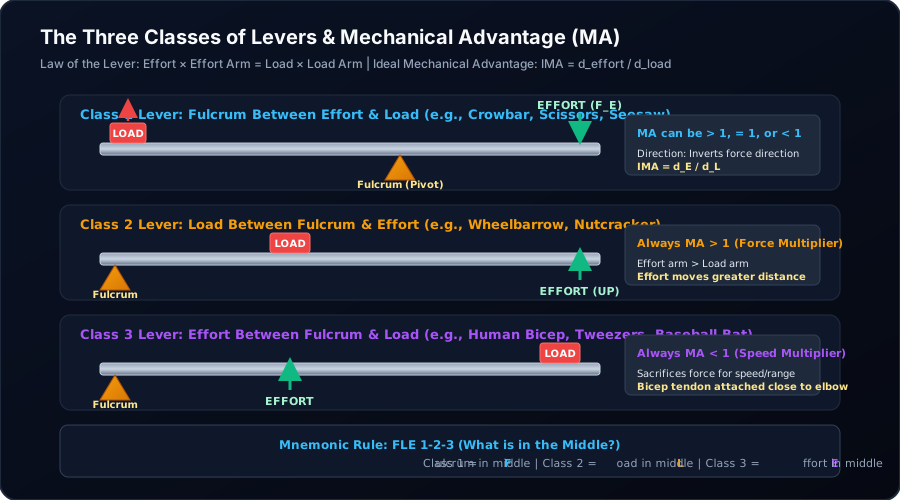
Figure 1.1: Comprehensive comparison of Class 1 (Fulcrum in middle), Class 2 (Load in middle), and Class 3 (Effort in middle) lever geometries and mechanical advantage characteristics.
Institutional Guide to Statics, Simple Machines & Mechanical Advantage
Authoritative engineering exposition covering Archimedes’ Law of the Lever, reeved pulley systems, inclined plane ramp forces, gear transmission speed-torque duality, centroid determination, and Coulomb friction.
1. The Law of the Lever & Archimedean Mechanical Advantage
In the 3rd century BCE, Greek mathematician Archimedes of Syracuse formulated the fundamental principle of the lever: "Give me a lever long enough and a fulcrum on which to place it, and I shall move the world."
Static moment equilibrium requires that the clockwise torques equal counterclockwise torques about the pivot fulcrum:
F_effort · d_effort = F_load · d_load ⇒ IMA = d_effort / d_load = F_load / F_effort
Levers are classified into three distinct physical architectures based on the relative positions of the Fulcrum, Load, and Effort (FLE):
- Class 1 (Fulcrum in Middle): Crowbars, seesaws, and scissors. Can have IMA > 1 (force multiplier), IMA = 1, or IMA < 1 (speed multiplier), while inverting the direction of applied force.
- Class 2 (Load in Middle): Wheelbarrows, nutcrackers, and door hinges. Because the effort arm always spans the entire lever while the load sits closer to the hinge, Class 2 levers always provide IMA > 1, multiplying lifting force at the expense of greater effort travel.
- Class 3 (Effort in Middle): Human bicep tendon flexing the forearm, tweezers, fishing rods, and baseball bats. Because the load arm exceeds the effort arm, Class 3 levers always provide IMA < 1. They sacrifice force to achieve tremendous speed and range of motion at the limb tip.
2. Pulley Systems, Reeving & Block and Tackle Mechanics
A pulley is a grooved wheel (sheave) designed to support movement and change the direction of tension along a flexible cable or rope. In multi-pulley block and tackle assemblies:
Ideal Mechanical Advantage: IMA = n (Number of supporting rope strands)
By conservation of mechanical work, lifting a load W through a vertical height h requires that the lead-line effort cable travel a stroke distance of d_effort = n · h. Each strand carries a tensile load of T = W / n. In cranes and heavy rigging, multiple sheaves distribute immense weights across standard wire ropes without exceeding allowable tensile working stress limits.
3. The Inclined Plane & The Angle of Repose
An inclined plane is a flat surface tilted at an angle θ relative to the horizontal, allowing heavy objects to be elevated with significantly reduced force:
IMA = L / h = 1 / sin(θ)
Decomposing the gravitational weight vector W = mg yields a normal compressive force F_N = mg cos θ and a parallel downslope component F_parallel = mg sin θ. To pull an object uphill at constant speed against surface friction (coefficient μ), the applied effort must overcome both gravity and friction:
F_pull = mg · [sin(θ) + μ_k · cos(θ)]
The Angle of Repose is the maximum slope angle at which an object resting on the incline will not slide spontaneously under its own weight. When tan(θ) = μ_s, gravity downslope force exactly balances maximum static friction. If the slope angle exceeds the angle of repose, spontaneous sliding occurs.
4. Gear Trains, Speed-Torque Duality & Multi-Body Centroids
Gear trains transmit rotary motion and power between shafts using intermeshing toothed wheels. Because the linear peripheral pitch velocity must match at the pitch contact point, the velocity ratio is inversely proportional to tooth counts:
Gear Ratio: GR = N_driven / N_driver = ω_in / ω_out = τ_out / (τ_in · η)
This fundamental duality dictates that whenever a gearbox reduces shaft speed (GR > 1), it multiplies mechanical drive torque by the exact same ratio, providing the massive wheel-turning torque required for automotive powertrains, robotics, and industrial winches.
In statics and structural mechanics, the Center of Mass (Centroid) represents the unique spatial balance point where the sum of gravitational moments equals zero:
x̄ = Σ (m_i · x_i) / Σ m_i, ȳ = Σ (m_i · y_i) / Σ m_i
In structural engineering, finding the centroid of composite cross-sections (T-beams, I-beams, box girders) is the mandatory first step in locating the neutral bending axis where normal bending stresses vanish.
Frequently Asked Questions (Statics & Simple Machines FAQ)
Can a simple machine create extra mechanical work or energy?
No. By the First Law of Thermodynamics, energy cannot be created. A machine with a Mechanical Advantage of 5 can reduce the required effort force by a factor of 5, but the operator must move the effort through 5 times the distance. Due to unavoidable frictional heat dissipation in bearings, pulleys, and gear teeth, the mechanical work output (W_out) is always strictly less than the work input (W_in), yielding an efficiency η < 100%.
Why does human anatomy rely predominantly on Class 3 levers with MA < 1?
In the human arm, the bicep muscle attaches to the radius bone just 3 to 5 cm from the elbow fulcrum, while the hand holds loads 30 to 40 cm away (IMA ≈ 0.1). Although the muscle must exert 1,000 N of force to hold a 100 N weight, a tiny muscle contraction of just 1 cm moves the hand through 10 cm of space at 10 times the velocity. Class 3 levers maximize human athletic speed, agility, and compact bodily form.
What is the difference between static friction and kinetic friction?
Static friction (coefficient μ_s) resists the initiation of sliding motion when two surfaces are at rest relative to each other. Microscopic surface roughness asperities interlock and form cold-welded junctions. Once the applied tangential force exceeds the breakaway threshold (f_s,max = μ_s F_N), these microscopic junctions shear off, and the surfaces begin sliding. During sliding, kinetic friction (coefficient μ_k) takes over. For nearly all materials, μ_k is 20% to 50% lower than μ_s, explaining why it is always harder to start sliding a heavy crate than to keep it sliding.
About Center of Mass Calculator
Find center of mass for system. Built for fast physics problem solving with step-by-step explanations, unit conversions, and practical help content.
Why this page helps
- Better than a plain formula page because it explains the result as well as calculates it
- Useful for school, college, exam practice, and quick engineering checks
- Helps reduce common unit-conversion mistakes
- Makes scenario testing faster with presets and instant recalculation
How to use it well
- Choose the Center of Mass Calculator and identify which motion values are already known.
- Enter the values carefully and set the matching units for distance, time, velocity, angle, or acceleration.
- Read the main answer first, then confirm the formula and the step-by-step derivation.
- Use the conversion output, graph, related tools, or download options if you need a report or comparison.