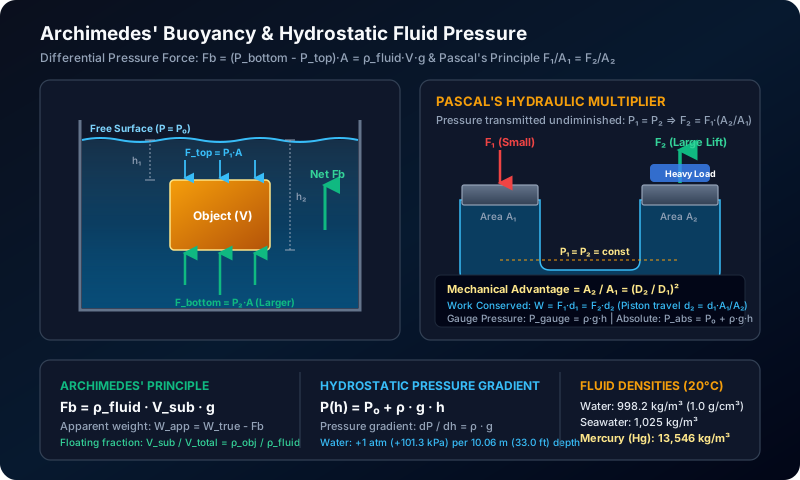

Institutional Guide to Fluid Statics, Archimedes Buoyancy & Pascal Hydraulics
Authoritative Reference: ISO 80000-4 Fluid Mechanics & Munson, Young and Okiishi's Fundamentals of Fluid Mechanics
1. Hydrostatic Pressure Gradient & Free Surface Law
In any static, incompressible fluid subjected to uniform gravitational acceleration g, internal shear stresses vanish identically, leaving purely isotropic normal compressive stresses (hydrostatic pressure). Balancing vertical gravitational weight against surface pressure forces across an infinitesimal fluid element of height dh yields:
Where P₀ is ambient atmospheric pressure at the free surface (101.325 kPa), and h is vertical submersion depth. In terrestrial seawater (ρ = 1,025 kg/m³), absolute hydrostatic pressure increases by exactly one standard atmosphere every 10.06 meters of depth.
2. Archimedes' Principle & Differential Pressure Origin
Archimedes of Syracuse (circa 250 BCE) formulated that any body completely or partially immersed in a fluid experiences an upward buoyant force Fb equal to the weight of the fluid displaced by the body:
The physical origin of buoyancy is the fundamental hydrostatic pressure differential: because fluid pressure increases with depth, the upward pressure force acting on the bottom surface of an immersed object (P_bottom·A) is strictly greater than the downward force on its top surface (P_top·A). The net resultant force is directed upward against gravity.
3. Flotation Equilibrium & Ballast Stability
A floating body achieves static vertical equilibrium when its total downward gravitational weight equals the upward buoyant force:
For pure water ice (ρ = 917 kg/m³) floating in seawater (ρ = 1,025 kg/m³), exactly 89.5% of an iceberg's bulk volume resides below the surface, with only 10.5% visible reserve buoyancy.
4. Pascal's Principle & Hydraulic Multipliers
Blaise Pascal (1653) demonstrated that pressure applied to an enclosed, incompressible fluid is transmitted undiminished to every portion of the fluid and to the walls of the containing vessel. In a two-piston hydraulic press with diameters D₁ and D₂:
While hydraulic mechanical advantage magnifies force by (D₂/D₁)², work is strictly conserved: the output piston stroke displacement d₂ is diminished by exactly the same ratio (d₂ = d₁·A₁/A₂), respecting energy conservation.