Institutional Guide to Fluid Dynamics, Torricelli Efflux & Reynolds Regimes
Authoritative Reference: ISO 5167 Measurement of Fluid Flow & Frank M. White, Fluid Mechanics
1. Continuity & Incompressible Conservation of Mass
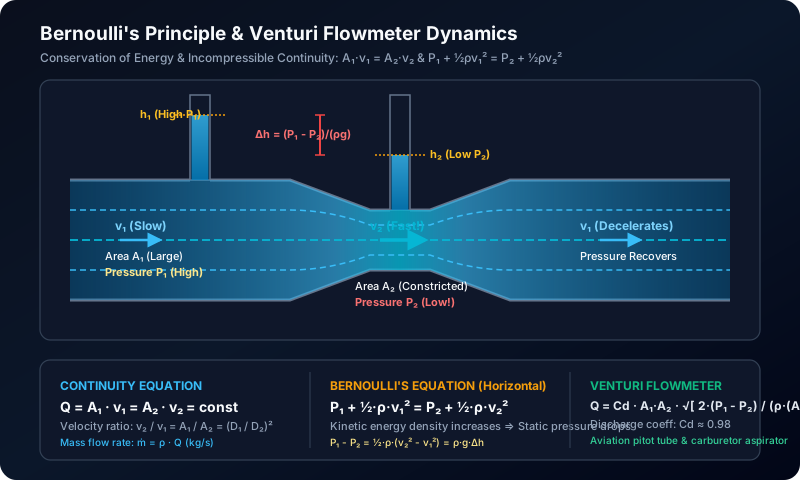
For steady, one-dimensional, incompressible fluid flow through an impermeable conduit with non-uniform cross-sectional area, conservation of mass requires the mass flow rate ṁ = ρ·Q to remain constant across all stations:
Because cross-sectional area scales with the square of diameter, halving the internal pipe diameter forces the fluid velocity to quadruple.
2. Bernoulli's Theorem & Venturi Pressure Differential
Daniel Bernoulli (1738) integrated Euler's equations of motion along an inviscid streamline, establishing that the sum of static pressure, dynamic pressure, and hydrostatic potential energy density is invariant:
In a horizontal Venturi constriction (z₁ = z₂), fluid accelerated through the narrower throat experiences an increase in kinetic energy density, compelling a corresponding reduction in static pressure. This pressure differential ΔP = P₁ - P₂ is exploited in Venturi flowmeters, aviation Pitot-static airspeeds, and chemical aspirators.
3. Torricelli's Law & Vena Contracta Efflux
Evangelista Torricelli (1643) deduced that the efflux velocity of liquid discharging under gravity from an orifice in an open tank at depth h equals the velocity a free-falling body would acquire falling from the same height:
Because fluid streamlines cannot negotiate a sharp 90° turn around the orifice rim, the liquid jet continues contracting beyond the aperture, reaching a minimum jet area at the vena contracta with contraction coefficient Cc ≈ 0.62. The actual volumetric discharge is calibrated by the discharge coefficient: Q = Cd·Ao·√(2gh).
4. Reynolds Number & Darcy-Weisbach Friction Losses
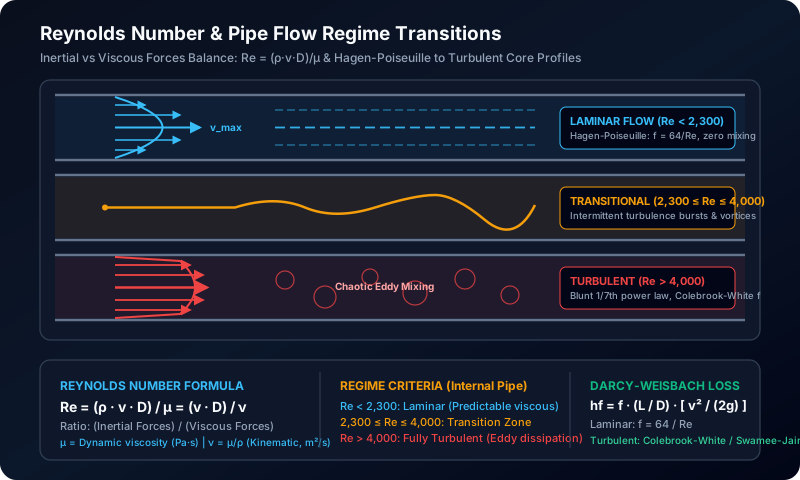
Osborne Reynolds (1883) demonstrated that fluid flow stability is governed by the dimensionless ratio of inertial forces to viscous shear forces:
For circular pipe flows: when Re < 2,300, viscous damping dominates, preserving smooth laminar concentric cylindrical fluid layers with parabolic velocity profiles. Above Re > 4,000, inertial momentum overpowers viscous dissipation, destabilizing the boundary layer into chaotic three-dimensional turbulent eddies. Head loss along a pipe length L is quantified by the Darcy-Weisbach equation: