Physics Calculator
Mechanics & Motion
Mechanics of Materials & Elastic Moduli Suite
Precision continuum mechanics engine solving tensile Hookean elasticity (E), circular shaft torsional shear rigidity (G), hydrostatic volumetric bulk compression (K), and transverse Poisson contraction (ν).
Hooke’s Law E = σ/εRigidity G = τ/γBulk K = -V(ΔP/ΔV)Poisson ν = -ε_t/ε_a
🏋️ Tensile Specimen & Applied Axial Load
Applied Axial Tensile Force (F)50 kN
Specimen Gauge Length (L_0)200 mm
Rod Diameter (D)20 mm
Hookean Tensile Stress, Strain & Elongation✔ Elastic Hookean Region
Tensile Stress (σ)
159.2 MPa
σ = F / A | Area = 314.2 mm²
Axial Elongation (ΔL)
0.159 mm
Strain: 796 µε (0.0796%)
Axial Stiffness (k)
314.2 kN/mm
k = A · E / L₀ (Equivalent Spring)
Yield Strength Utilization: σ / σ_y (250 MPa)63.7%
Modulus of Resilience (U_r): 156.25 kJ/m³
Stored Elastic Energy (U): 3.98 Joules
📊 Engineering Stress-Strain Curve, Hooke's Law & Yield Strength
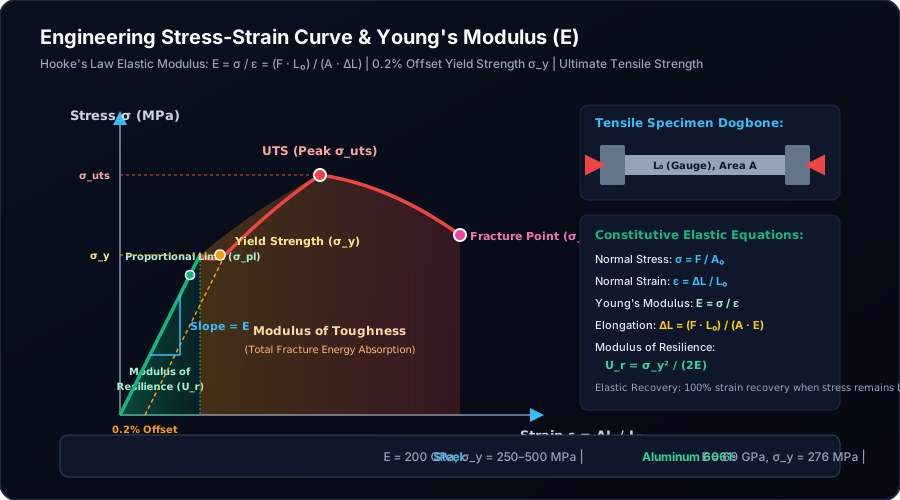
Figure 1.1: Complete engineering tensile stress-strain behavior showing linear elastic slope E = σ/ε, 0.2% offset yield strength (σ_y), ultimate tensile strength (UTS), modulus of resilience, and fracture toughness.
Institutional Guide to Elasticity, Stress-Strain Mechanics & Moduli
Authoritative reference covering Hookean tensile elasticity, shear stress in drive shafts, hydrostatic bulk compressibility, Poisson’s ratio, and the interconversion of isotropic continuum parameters.
1. Young's Modulus & Uniaxial Tensile Stress-Strain Dynamics
In 1807, British polymath Thomas Young formalized the concept of the modulus of elasticity, defining the fundamental linear relationship between normal tensile stress (force per unit cross-sectional area, σ = F / A) and normal engineering strain (fractional change in length, ε = ΔL / L₀):
E = σ / ε = (F · L₀) / (A · ΔL)
Young's modulus represents the stiffness of a material—its resistance to elastic elongation under tensile or compressive load. In a standard dogbone tensile test (ASTM E8 / ISO 6892), a specimen passes through distinct mechanical deformation regimes:
- Proportional Limit (σ_pl): The maximum stress up to which Hooke's Law remains strictly linear.
- Elastic Limit & Yield Strength (σ_y): The boundary beyond which plastic (permanent) dislocation motion occurs. For ductile metals lacking an abrupt yield drop, engineering standard practice dictates the 0.2% offset yield strength (a parallel line offset by ε = 0.002).
- Modulus of Resilience (U_r): The maximum elastic strain energy a material can absorb per unit volume without permanent set: U_r = σ_y² / (2E).
- Ultimate Tensile Strength (UTS): The peak engineering stress before macroscopic necking and localized micro-void coalescence culminate in rupture.
2. Shear Modulus of Rigidity (G) & Drive Shaft Torsion Mechanics
While Young's modulus governs normal tensile and compressive forces, the Shear Modulus of Rigidity (G) governs tangential sliding deformation and torsional twisting:
τ = G · γ
where τ is the shear stress and γ is the shear strain angle (in radians). In mechanical powertrain design (automotive drive shafts, marine propeller shafts, turbine rotors), circular members are subjected to pure twisting torque T:
Polar Moment of Inertia: J = π · (D_o⁴ - D_i⁴) / 32
Maximum Outer Shear Stress: τ_max = (T · R) / J = (16 · T · D_o) / [π · (D_o⁴ - D_i⁴)]
Angular Twist Deflection: θ = (T · L) / (G · J) (radians)
Because shear stress increases linearly from zero at the center axis to a maximum at the outer surface, solid shafts waste material near the neutral core. Replacing a solid shaft with a thin-walled hollow tube (D_i / D_o ≈ 0.8) reduces structural mass by 64% while sacrificing only 20% of its torsional load capacity.
3. Bulk Modulus (K), Volumetric Compressibility & Speed of Sound
When a body is submerged in a fluid or subjected to uniform confining pressure ΔP from all spatial directions, it undergoes uniform volumetric contraction without change of shape. The Bulk Modulus (K) measures resistance to uniform volumetric compression:
K = -V₀ · (ΔP / ΔV) = ΔP / ε_v
The negative sign ensures that K remains positive, since an increase in pressure (+ΔP) causes a decrease in volume (-ΔV). The reciprocal of bulk modulus is isothermal compressibility: β = 1 / K.
In geophysics, oceanography, and acoustic engineering, the bulk modulus directly dictates the speed of longitudinal compression waves (acoustic sound velocity, P-waves):
c = √(K / ρ)
For liquid water at 20°C (K ≈ 2.2 GPa, ρ = 998 kg/m³), the acoustic speed of sound is c ≈ √(2.2 × 10⁹ / 998) ≈ 1,484 m/s—over 4.3 times faster than the speed of sound in air (343 m/s), explaining the exceptional efficiency of marine sonar transmission.
4. Poisson's Ratio (ν) & The Complete Elastic Moduli Interconversion
In 1827, French mathematician Siméon Denis Poisson demonstrated that when an isotropic solid is stretched axially along one direction, it simultaneously undergoes lateral contraction in both transverse orthogonal directions:
ν = - (ε_transverse / ε_axial) = - (Δd / d₀) / (ΔL / L₀)
For any homogeneous isotropic material, thermodynamics requires that the strain energy function remains positive-definite, strictly limiting Poisson’s ratio to the theoretical range:
-1.0 ≤ ν ≤ +0.5
The physical extremes of this spectrum reveal critical engineering behaviors:
- ν = 0.50 (Incompressible Rubber & Liquids): The material undergoes zero volumetric change during deformation (ΔV = 0), and bulk modulus K → ∞.
- ν ≈ 0.28 to 0.33 (Structural Metals): Typical structural steels and aluminum alloys lose slight volume under uniaxial tension while necking transversely.
- ν ≈ 0.00 (Natural Cork): Under compressive insertion into a wine bottle neck, cork contracts axially without expanding laterally, preventing bottle jamming.
- ν < 0 (Auxetic Metamaterials): Engineered re-entrant microstructures (such as expanded PTFE, Gore-Tex, and 3D-printed auxetic honeycombs) paradoxically expand laterally when stretched axially, providing extraordinary indentation resistance and energy absorption in bulletproof vests and biomedical stents.
Any homogeneous isotropic material is completely defined by just two independent elastic constants. All other constants can be computed via exact continuum identities:
G = E / [2 · (1 + ν)]
K = E / [3 · (1 - 2ν)]
E = (9 · K · G) / (3 · K + G)
ν = (3K - 2G) / [2 · (3K + G)]
Frequently Asked Questions (Mechanics of Materials FAQ)
What is the difference between stiffness, strength, and toughness?
Stiffness is governed by Young’s Modulus (E) and measures elastic resistance to deflection (slope of stress-strain curve). Strength is governed by Yield Strength (σ_y) and Ultimate Tensile Strength (UTS), measuring the stress required to cause plastic deformation or rupture. Toughness is the total area under the entire stress-strain curve up to fracture, measuring the total energy a material can absorb before catastrophic rupture. High-strength materials like hardened tool steel can be brittle with low toughness, whereas structural mild steel exhibits lower strength but exceptional toughness.
Why does heat treatment change a steel's strength but not its Young's modulus?
Young’s modulus (E ≈ 200 GPa for steel) is an intrinsic property determined by the fundamental interatomic iron-iron bond stiffness of the crystal lattice, which remains virtually unchanged by heat treatment or minor alloying. In contrast, yield strength and tensile strength depend on microscopic grain size, phase boundaries, and dislocation pinning mechanisms (martensite formation, precipitation hardening), which are dramatically altered by quenching and tempering.
Why does a hollow shaft have higher torsional efficiency than a solid shaft of equal weight?
In circular torsion, shear stress increases linearly with radius (τ = T · r / J). Material near the center carries near-zero stress while adding dead weight. By redistributing that material to a larger outer diameter in a hollow tube, the polar moment of inertia (J ∝ D⁴) increases exponentially, maximizing torque resistance per kilogram of material.
What happens to Bulk Modulus (K) when Poisson's ratio approaches 0.5?
In the relation K = E / [3(1 - 2ν)], as ν approaches 0.5, the denominator (1 - 2ν) approaches zero, causing the theoretical Bulk Modulus K to approach infinity. This defines a perfectly incompressible material (such as ideal elastomers or liquid water), which can deform in shear (G > 0) but cannot be compressed into a smaller volume under hydrostatic pressure.
About Young's Modulus Calculator
Calculate stress and strain. Built for fast physics problem solving with step-by-step explanations, unit conversions, and practical help content.
Why this page helps
- Better than a plain formula page because it explains the result as well as calculates it
- Useful for school, college, exam practice, and quick engineering checks
- Helps reduce common unit-conversion mistakes
- Makes scenario testing faster with presets and instant recalculation
How to use it well
- Choose the Young's Modulus Calculator and identify which motion values are already known.
- Enter the values carefully and set the matching units for distance, time, velocity, angle, or acceleration.
- Read the main answer first, then confirm the formula and the step-by-step derivation.
- Use the conversion output, graph, related tools, or download options if you need a report or comparison.