Physics Calculator
Mechanics & Motion
🛰️ Orbital Trajectory Inputs
Low Earth Orbit, 92.7 min period, v ≈ 7.66 km/s
5.9722e+24 kg
6,779 km
0.0005
0.0 (Circular)0.5 (Moderate Ellipse)0.95 (Highly Elliptical)
6,779 km
42,164 km
Vis-Viva Orbital Kinematics & Period
v(r) = √(GM(2/r - 1/a))Speed at Radius r (v)
7.668 km/s
27,605 km/h
Orbital Period (T)
1.54 hr
92.6 minutes (5,555 s)
Total Hohmann Δv
3.854 km/s
Transfer Time: 5.29 hours
Periapsis Velocity (v_p):7.672 km/sAt r_p = 6,775.611 km
Apoapsis Velocity (v_a):7.664 km/sAt r_a = 6,782.39 km
Burn 1 Δv₁ (Periapsis):2.397 km/s
Burn 2 Δv₂ (Apoapsis):1.456 km/s
Step-by-Step Vis-Viva & Orbital Solution:
1. Gravitational parameter: μ = G · M = 6.6743e-11 × 5.972e+24 = 3.9860e+14 m³/s²
2. Vis-Viva Equation: v² = μ · [ 2/r - 1/a ] = 3.986e+14 × [ 2/(6779 km) - 1/(6779 km) ]
3. Orbital speed: v = 7.6681 km/s (27,605 km/h)
4. Orbital period: T = 2π √(a³ / μ) = 5555 s = 92.58 min = 1.543 hours
5. Hohmann transfer budget: Injection Δv₁ = 2.397 km/s, Circularization Δv₂ = 1.456 km/s ➔ Total Δv = 3.854 km/s
🌌 Architectural Vector Schematics & Astrodynamic Orbital Geometry
Zero-blur vector visualizers of gravitational potential wells, Vis-Viva velocity vectors, Hohmann transfers, and Keplerian harmonic planetary sweeps.
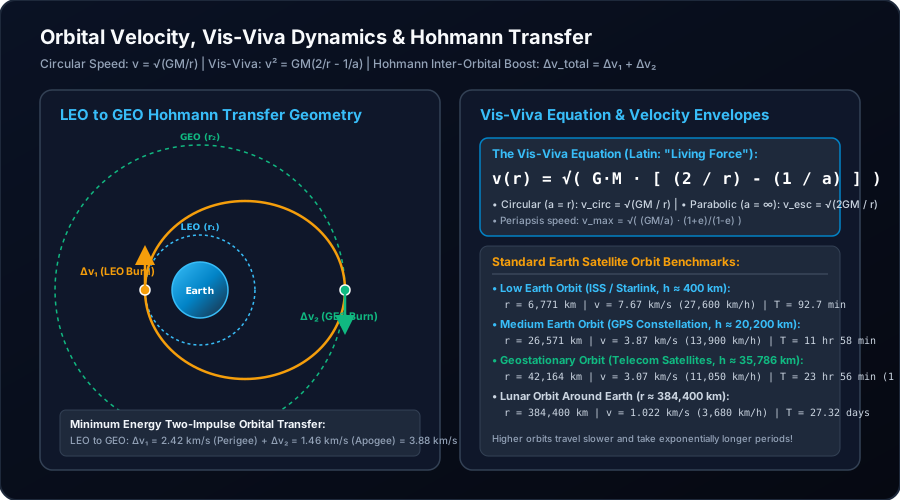
Figure 1: LEO to GEO Hohmann Two-Impulse Transfer Trajectory and Vis-Viva Velocity Envelopes.

Figure 2: Empirical Keplerian Third Law Invariant T² = a³ Across All Solar System Planets.
Institutional Reference: Orbital Mechanics, Gravitational Fields & Astrodynamics
Authoritative Engineering Guide on Gravitational Potential Wells, Vis-Viva Energy Invariants, Hohmann Orbital Transfers, and Kepler's Harmonic Laws.
1. Newton's Universal Law of Gravitation & The Potential Well
In celestial mechanics, the gravitational attraction between two point masses M and m separated by distance r is governed by Newton's Universal Law of Gravitation:
F_grav = G · M · m / r²
Where G = 6.67430 × 10⁻¹¹ m³/(kg·s²) is the universal gravitational constant. Because gravity is a conservative central force directed toward the center of mass, the associated gravitational potential energy U(r) is defined relative to an infinite reference boundary (U(∞) = 0):
U(r) = -∫_{∞}^{r} F_grav dr' = - (G · M · m) / r
Every celestial body creates a negative gravitational potential well. To move a spacecraft from radius r to infinity requires doing positive external work equal to +GMm / r, climbing out of the celestial gravity well.
2. Escape Velocity & The √2 Invariant
The escape velocity v_esc is defined as the minimum initial speed required for an unpropelled ballistic projectile to escape to infinity without ever falling back:
E_total = K + U = ½ · m · v_esc² - (G · M · m) / R = 0 ➔ v_esc = √( (2 · G · M) / R ) = √( 2 · g · R )
Remarkably, the escape velocity from any circular orbit of radius r is exactly related to the circular orbital speed v_circ by the factor of √2:
v_circ = √(G · M / r) and v_esc = √2 · v_circ ≈ 1.4142 · v_circ
A spacecraft already maintaining a circular Low Earth Orbit at 7.67 km/s requires an additional velocity boost of only 41.4% (an extra 3.18 km/s) to permanently break free from Earth's gravity well into interplanetary space.
If the initial launch speed v₀ exceeds v_esc, the spacecraft retains a non-zero velocity at infinite distance, known as the hyperbolic excess velocity v_inf:
v_inf = √( v₀² - v_esc² )
This principle enabled interplanetary probes like Voyager 1, Voyager 2, and New Horizons to achieve interstellar escape trajectories into the Milky Way galaxy.
3. The Vis-Viva Equation & The Hohmann Transfer
In Keplerian orbital mechanics, the Vis-Viva Equation (Latin for "living force") directly relates the instantaneous speed v of an orbiting body at distance r to the orbit's semi-major axis a:
v² = G · M · [ (2 / r) - (1 / a) ]
This fundamental equation unifies all four conic sections:
- Circular Orbit (r = a): v = √(GM / r) = constant.
- Elliptical Orbit (0 < e < 1): Speed oscillates between periapsis maximum v_peri = √[(GM/a)·(1+e)/(1-e)] and apoapsis minimum v_apo = √[(GM/a)·(1-e)/(1+e)].
- Parabolic Orbit (a = ∞): v = √(2GM / r) = v_esc.
- Hyperbolic Orbit (a < 0): v > v_esc everywhere.
To transfer a spacecraft from a circular inner orbit r₁ (e.g. LEO) to an outer orbit r₂ (e.g. GEO), the German engineer Walter Hohmann demonstrated in 1925 that an elliptical transfer orbit tangent to both circular orbits minimizes total fuel consumption (Δv):
Δv₁ = √(GM / r₁) · [ √( 2·r₂ / (r₁ + r₂) ) - 1 ] | Δv₂ = √(GM / r₂) · [ 1 - √( 2·r₁ / (r₁ + r₂) ) ]
4. Kepler's Three Laws of Planetary Motion
Between 1609 and 1619, Johannes Kepler analyzed decades of high-precision astronomical observations recorded by Tycho Brahe, discovering the three empirical laws that dismantled the geocentric Ptolemaic model:
1st Law: The Law of Ellipses
The orbit of a planet is an ellipse with the Sun located at one of the two foci. The other focus is empty space.
2nd Law: Equal Swept Areas
A line segment joining a planet and the Sun sweeps out equal areas in equal intervals of time (dA/dt = L/2m = const), proving angular momentum conservation.
3rd Law: The Harmonic Law
The square of the orbital period T of a planet is directly proportional to the cube of the semi-major axis a of its orbit: T² = (4π²/GM) a³.
❓ Frequently Asked Questions (FAQ)
Why is escape velocity independent of the mass of the escaping spacecraft?▼
Both kinetic energy (½ m v²) and gravitational potential energy (-GMm/r) are directly proportional to the mass m of the escaping object. Setting total mechanical energy to zero (½ m v² - GMm/r = 0), the mass term m cancels out identically: v_esc = √(2GM/r). A 1-gram pebble and a 100-ton spaceship require the exact same escape speed (11.19 km/s from Earth's surface).
What is the difference between orbital velocity and escape velocity?▼
Circular orbital velocity (v_circ = √(GM/r)) is the horizontal speed needed to fall around a planet in a perpetual closed circle where gravitational acceleration equals centripetal acceleration. Escape velocity (v_esc = √(2GM/r)) is the speed required to break out of orbit entirely onto an open parabolic trajectory, traveling to infinite distance without falling back. Escape speed is always exactly √2 (41.4%) faster than circular orbital speed at the same radius.
What is a Hohmann transfer and why is it fuel-optimal?▼
A Hohmann transfer is an elliptical trajectory tangent to both the departure and destination circular orbits. Because the velocity change burns (Δv₁ and Δv₂) occur purely tangentially at the periapsis and apoapsis, they exploit the Oberth effect to maximize specific kinetic energy change per unit propellant, making it the most fuel-efficient two-impulse transfer possible between coplanar circular orbits.
Why do outer planets in our Solar System take so much longer to orbit the Sun?▼
Kepler's Third Law states that orbital period scales with distance to the 3/2 power (T = a^(3/2) in solar units). Outer planets not only have vastly longer orbital circumferences to travel (C = 2πa), but their circular orbital speeds are also significantly slower (v = √(GM/r)). For instance, Neptune is 30.1 AU away: its orbital speed is only 5.4 km/s (compared to Earth's 29.8 km/s), resulting in an orbital period of 165 Earth years!
About Orbital Mechanics
Calculate orbital speed for satellites and space objects. Built for fast physics problem solving with step-by-step explanations, unit conversions, and practical help content.
Why this page helps
- Better than a plain formula page because it explains the result as well as calculates it
- Useful for school, college, exam practice, and quick engineering checks
- Helps reduce common unit-conversion mistakes
- Makes scenario testing faster with presets and instant recalculation
How to use it well
- Choose the Orbital Mechanics and identify which motion values are already known.
- Enter the values carefully and set the matching units for distance, time, velocity, angle, or acceleration.
- Read the main answer first, then confirm the formula and the step-by-step derivation.
- Use the conversion output, graph, related tools, or download options if you need a report or comparison.