Physics Calculator
Mechanics & Motion
🎱 1D Collision Parameters
Cue ball striking stationary object ball with e = 0.96
Object 1 (Incident / Incoming)
Object 2 (Target / Second Mass)
0.96
0.0 (Stick Together)0.5 (Inelastic)1.0 (Perfect Elastic)
Post-Collision Velocities & Kinetic Partition
Inelastic CollisionObject 1 Velocity (v₁)Initial: 3.5 m/s
0.070 m/s
Post-impact momentum: 0.01 kg·m/s
Object 2 Velocity (v₂)Initial: 0 m/s
3.430 m/s
Post-impact momentum: 0.58 kg·m/s
Kinetic Energy Dissipation:3.9% Lost (0.04 Joules)
Initial KE: 1.04 JFinal KE: 1.00 J
Total Initial Momentum:0.595 N·s
Total Final Momentum:0.595 N·s
Center of Mass Speed:1.750 m/s
Relative Separation:3.360 m/s
Step-by-Step Restitution Solution:
1. Linear momentum conservation: m₁u₁ + m₂u₂ = m₁v₁ + m₂v₂ = 0.595 kg·m/s
2. Restitution relation: (v₂ - v₁) = e · (u₁ - u₂) = 0.96 × (3.5 - 0) = 3.360 m/s
3. Object 1 post-collision velocity: v₁ = [ 0.17×3.5 + 0.17×0 - 0.17×0.96×(3.50) ] / 0.34 = 0.070 m/s
4. Object 2 post-collision velocity: v₂ = [ 0.17×3.5 + 0.17×0 + 0.17×0.96×(3.50) ] / 0.34 = 3.430 m/s
5. Energy conservation audit: K_i = 1.04 J, K_f = 1.00 J ➔ ΔK = 0.04 J (3.9% dissipated into heat/sound)
📊 Architectural Vector Schematics & Dynamic Collision Physics
Crystal-clear zero-blur vector diagrams illustrating the impulse-momentum theorem, elastic vs inelastic restitution, and conservation of angular momentum.
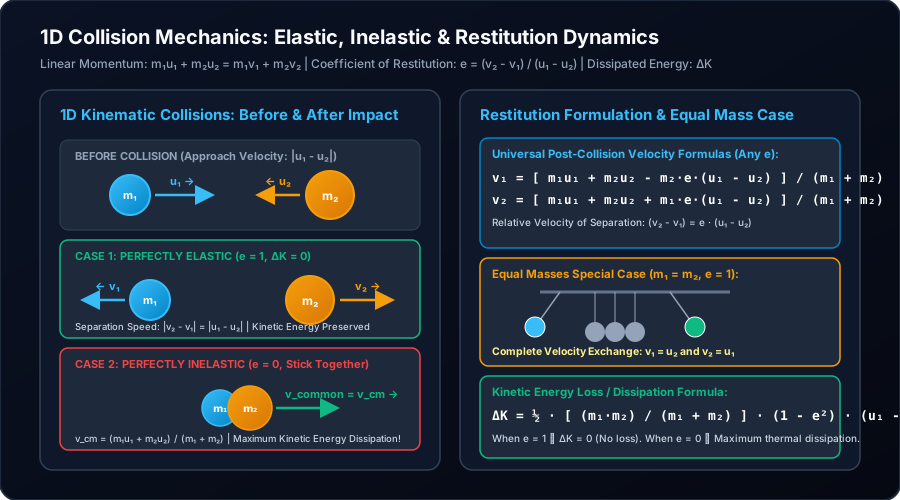
Figure 1: 1D Elastic (e=1) and Perfectly Inelastic (e=0) Collision Restitution Vectors.

Figure 2: Angular Momentum Conservation L = Iω and Muscular Centrifugal Work Conversion.
Institutional Reference: Momentum, Impulse, Collisions & Rotational Mechanics
Authoritative Engineering Treatise on the Impulse-Momentum Theorem, Restitution Dynamics, Crash Deceleration G-Forces, and Angular Conservation.
1. Foundations of Momentum & Newton's Second Law
In classical Newtonian mechanics, linear momentum represents the quantity of translational motion possessed by an object, defined mathematically as the product of inertial mass and instantaneous velocity vector:
p = m · v [kg·m/s]
Isaac Newton originally formulated his Second Law of Motion in terms of the rate of change of momentum rather than mass times acceleration: the net external force acting on a particle is identically the first time derivative of its linear momentum:
F_net = dp / dt = d(m · v) / dt = m · (dv / dt) = m · a (for constant mass)
This fundamental formulation leads directly to the Law of Conservation of Linear Momentum: in any isolated mechanical system free from net external forces (F_net = 0), the vector sum of momenta of all interacting bodies remains constant in time.
2. The Impulse-Momentum Theorem & Crash Safety Engineering
Integrating Newton's Second Law over a finite time interval from t₁ to t₂ establishes the Impulse-Momentum Theorem:
J = ∫_{t₁}^{t₂} F(t) dt = F_avg · Δt = Δp = m · (v_f - v_i)
The impulse J is a vector quantity having SI units of Newton-seconds (N·s), which are dimensionally equivalent to kg·m/s. Geometrically, the impulse corresponds to the definite integral (area under the curve) of the force-time history F(t).
In automotive crash safety and athletic protective gear, a stopping vehicle or falling human must absorb a predetermined change in momentum Δp. Because J is fixed by the initial mass and travel speed, the average impact force experienced by human occupants is inversely proportional to collision duration:
F_avg = Δp / Δt
By designing progressive automotive crumple zones, front-end crush rails, and rapid deployment airbags, automotive safety engineers prolong the deceleration duration from approximately 15 milliseconds (a rigid barrier collision) to over 120 milliseconds. This 8-fold increase in duration reduces average impact forces and deceleration from fatal levels (>100 G) down to survivable thresholds (~15 G), saving hundreds of thousands of lives annually.
3. 1D Collision Theory & The Coefficient of Restitution
When two bodies collide in one dimension, total linear momentum is always conserved regardless of whether the collision is elastic or inelastic:
m₁ · u₁ + m₂ · u₂ = m₁ · v₁ + m₂ · v₂ = (m₁ + m₂) · v_cm
To uniquely determine both post-collision velocities (v₁ and v₂), a second constitutive relationship is required: Newton's Law of Restitution. The dimensionless Coefficient of Restitution (e) measures the ratio of the relative speed of separation to the relative speed of approach along the line of impact:
e = (v₂ - v₁) / (u₁ - u₂) (where 0 ≤ e ≤ 1)
Combining momentum conservation with restitution yields universal analytical equations for post-collision speeds:
Body 1 Final Velocity (v₁)
v₁ = [ m₁u₁ + m₂u₂ - m₂·e·(u₁ - u₂) ] / (m₁ + m₂)
Body 2 Final Velocity (v₂)
v₂ = [ m₁u₁ + m₂u₂ + m₁·e·(u₁ - u₂) ] / (m₁ + m₂)
Classification of Collisions by Restitution:
- Perfectly Elastic (e = 1): Kinetic energy is completely conserved (ΔK = 0). Characteristic of billiard balls, Newton's cradle, and subatomic particle scattering. When masses are equal (m₁ = m₂), the bodies completely exchange velocities (v₁ = u₂, v₂ = u₁).
- Inelastic (0 < e < 1): Momentum is conserved, but a fraction of kinetic energy is permanently converted into thermal energy, acoustic emissions, and plastic deformation.
- Perfectly Inelastic (e = 0): The bodies stick together and move with a single common velocity v₁ = v₂ = v_cm. This represents the maximum possible kinetic energy loss allowed by the laws of physics.
4. Angular Momentum & The Figure Skater Spin-Up Paradox
Rotational motion is the direct angular analogue of linear translation. The angular momentum of a rigid body rotating about a fixed principal symmetry axis is given by:
L = I · ω [J·s ≡ kg·m²/s]
Where I is the mass moment of inertia and ω is the angular velocity in rad/s. For a point particle at position r with linear momentum p, orbital angular momentum is the vector cross product:
L = r × p = m · (r × v) = m · v · r · sin(θ)
When no net external torque acts on a rotating system (τ_net = dL/dt = 0), total angular momentum is strictly conserved:
I₁ · ω₁ = I₂ · ω₂ = Constant
The Spin-Up Kinetic Energy Paradox: When an ice figure skater starts a spin with extended arms (large I₁) and then pulls their arms and legs tightly inward against their torso (small I₂), their angular velocity increases dramatically by the ratio I₁ / I₂. Curiously, their rotational kinetic energy also increases:
K_rot = ½ · I · ω² = L² / (2 · I)
Because L is constant, rotational kinetic energy is inversely proportional to moment of inertia I! Reducing moment of inertia by a factor of 4 causes kinetic energy to quadruple. This extra energy does not violate energy conservation: it is supplied by the positive muscular work done by the skater's biceps and core muscles pulling their limbs inward against outward centrifugal pseudo-force.
❓ Frequently Asked Questions (FAQ)
What is the physical difference between force and impulse?▼
Force (measured in Newtons) is an instantaneous rate of change of momentum (F = dp/dt). Impulse (measured in N·s or kg·m/s) is the cumulative product or integral of force exerted over a finite time duration (J = ∫F dt = F_avg · Δt). A small force applied over a long time duration can produce the exact same impulse and velocity change as an enormous force applied over a microsecond.
Why is kinetic energy not conserved in inelastic collisions, even though momentum is?▼
Momentum conservation stems from Newton's Third Law (equal and opposite forces during contact), which guarantees that internal forces cancel out in pairs regardless of material properties. Kinetic energy, however, depends on the work done by conservative restoring forces. In inelastic collisions, part of the collision work permanently breaks atomic bonds, bends metal, creates acoustic waves, or produces frictional heat. Total energy across the universe is conserved, but mechanical kinetic energy is dissipated into internal thermal energy.
What is the coefficient of restitution and how is it measured?▼
The coefficient of restitution (e) is a dimensionless index between 0 and 1 defining the elasticity of an impact: e = |v₂ - v₁| / |u₁ - u₂|. Experimentally, dropping a ball onto a rigid floor from height h₁ and measuring rebound height h₂ provides the coefficient directly: e = √(h₂ / h₁).
Where does the extra kinetic energy come from when an ice skater spins faster?▼
When a skater contracts their arms inward, they must pull against centrifugal force. The mechanical work done by the skater's muscles (W = ∫ F_centrifugal dr) is positive work done on the rotating mass, directly converting stored biochemical ATP energy into additional rotational kinetic energy: ΔK = K₂ - K₁ = L²/(2I₂) - L²/(2I₁) > 0.
About Collision Calculator
Analyze elastic and inelastic collisions. Built for fast physics problem solving with step-by-step explanations, unit conversions, and practical help content.
Why this page helps
- Better than a plain formula page because it explains the result as well as calculates it
- Useful for school, college, exam practice, and quick engineering checks
- Helps reduce common unit-conversion mistakes
- Makes scenario testing faster with presets and instant recalculation
How to use it well
- Choose the Collision Calculator and identify which motion values are already known.
- Enter the values carefully and set the matching units for distance, time, velocity, angle, or acceleration.
- Read the main answer first, then confirm the formula and the step-by-step derivation.
- Use the conversion output, graph, related tools, or download options if you need a report or comparison.